springtbh_905


STACEY: Hi Lucy, thanks for agreeing to answer some q’s. You run an online lit journal called Shabby Doll House, do you want to tell us a little bit about that?

SHABBY DOLL HOUSE: Hi Stacey.

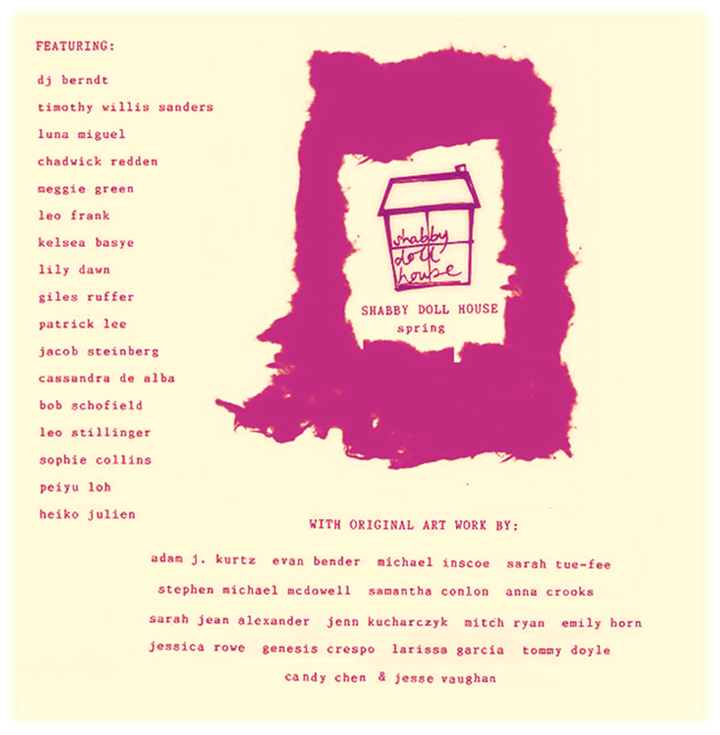
Shabby Doll House (est. 2012) is an online publication that I started in order to showcase work that I felt excited about, but that didn’t seem to have a home. We publish various forms of literature alongside original visual artworks made specifically to accompany the writing. We have published short stories, poetry, tweet compilations, gchats, watercolour paintings, .gifs, photographs, collages… It is kind of a mix of everything, but I think it has developed a particular style and sense of aesthetic.


I edit the website with Sarah Jean Alexander, and we aim to curate a cohesive collection of work every quarter. The general theme or aim, I think, is to distract or prevent people from feeling lonely.


S: Seems like a good thing for a online publication to want to achieve. What is the submission process like and roughly how many pieces would you get for every issue? Are there particular things you look for when selecting?

SDH: We received around 150 submissions for the last issue and published 17 of them, so we are able to be pretty selective, which is nice. I feel really good about all of the work we have published so far.

I don’t think I can articulate what we’re looking for exactly, other than to say I’m attracted to things that feel honest/funny/sad/new/comforting to me, maybe… Generally, I just seem to know straight away if something is a good match.

I’d recommend that people wanting to submit should read the site and then send whatever feels right/real/exciting to them. I’m interested in finding innovative ways to tell stories. Interested in not feeling bored. Interested in being shocked by the possibilities of poetry… I want what we’re doing to continue evolving. I want people to us send things that they feel nervous about.

S: Another thing I have noticed with regards to Shabby Doll House is the way you seem to ‘nurture’ your current and past contributors. If you look at your tumblr, Facebook or twitter, you are always re-posting things related to people involved with SDH, I guess in the same vein as Pop Serial. You also do a ‘news roundup’ type thing. Did you start doing this intuitively and do you think it makes your publication stronger in any way?

SBH: Nice. I’m happy that you think that. I think it’s intuitive to a certain point and then I try to go beyond that and to think of different ways that we can support people’s work. I definitely want there to be a sense of community about Shabby Doll House, and I want to be able to give our contributors a platform to find a larger or different audience for their work, once we’ve published them.

But also, I think it’s a cyclical thing, because every time we publish a new person, we are introduced to their circle of friends etc. Everybody is sort of helping each other. I’m just excited that all of these people are alive at the same time as me and that, thanks to the internet, we can now work together so easily. We’re incredibly lucky in that sense. It is easier than it ever has been to find other people who are like you.

S: What is your/Shabby Doll House’s relationship with “alt lit”?

SDH: Kind of feels like being associated with alt lit is like having a brother that you don’t really get along with, because everything he says seems insane and makes you feel embarrassed, but if anybody outside of your family insults him, you feel defensive and want to protect him because he’s still your family, or something…

S: I used to feel more negatively about alt lit than I do now. I feel more open to it, and think that there are good things happening within it, you just have to pick out what you like and leave the rest. More than anything I think that alt lit is a place for people to come together, like what you were saying about community, I think it is a nice thing to have that kind of support system as a writer. How do you think being a part of “alt lit” (is it okay that I am putting it in scare quotes?) affects your writing?

SDH: I appreciate the lack of pretense,  I like that people don’t feel the need to dress their emotions up in literary devices. I think that’s what I feel most excited about and affected by in relation to my writing.

I think there is more to it than that though. I feel very fortunate to be part of a group of writers who work hard and support each other, and I feel encouraged by the responses I get from them. I think I’m more productive because I’m part of something that’s bigger than just me. I feel like I’ve met people who want to do the same things that I want to do, for the first time in my life probably, so as much as it is easy to complain about a lot of things within ‘the community’, I think we’re all extremely lucky to have collided somehow.

When you look at how people’s closest friends are scattered around the whole world, you can understand the extent to which these people need each other. I think it’s going to be interesting to see what happens to ‘it’ and to everybody, as time goes on/things develop.

S: Yeah, I feel interested in that also. It’s nice to feel like you will always have an audience, particularly because that audience happen to be your friends. What does the future have in store for Shabby Doll House?

SDH: We will do three more issues this year, and there are going to be a bunch of readings in the summer time in the US and Canada. Also we’re going to be putting together a print book in the fall with new content from some of our past contributors, so that’s something I’m really looking forward to.


You can read past issues of Shabby Doll House here (http://shabbydollhouse.com/) and you can contribute by emailing shabbydollsubmissions@gmail.com


907030_10151605141308615_1865501815_n

Stacey Teague’s fave types of nuts are almonds, pistachios and cashews. Least fave are brazil nuts and walnuts. Blogs at staceyteague.tumblr.com

Sherry O’Keefe presents us with 4 vignettes which teach us how to launder our own imagery. This post reminds us constantly to look around ourselves, even the smallest of happenings are ones which can be spun into a poem or a story. Everything has a story. Everybody is their own storyteller.


Sugar On a Rope:

He told me potatoes were complicated. I know this is true because I wrote it on a scrap of paper and saved it in my back pocket. Some conversations later, I retrieved the scrap of paper from the lint trap in my dryer. Apparently I had laundered the words when I washed my jeans. The scrap of paper looked a bit like a former leaf, except I could see these words in faded ink: potatoes are complicated and some poems are born in badness. The trouble is I cannot remember the conversation that produced these quotes. I don’t remember anymore where these words came from.

I don’t always know what to keep and what to let go. I’m not the sort to let anything go. There are scraps of paper all over my house. For example, these are the words next to my kitchen sink: We don’t even need to talk about houses on the hill. As writers we deal with the hanging on and the not knowing when to let go.

When he talks to me, he uses panoramic strokes, coaxing me to see the big picture. And for a bit of time, I am right there with him, seeing the big picture. And in fact, I am enjoying the wide view his words offer . . . but then something happens as we keep talking. It is as though we go around a bend, chattering and laughing.

But the poetry-gene activates and the next thing I know I am on my knees, examining something minute, something telescopic.

Later, I will find more random words on scraps of paper:

sugar on a rope, failed harbor

What does it mean to want to be heard?

Little men lined up like starfish on the edge of a tidal pool

Did anything happen in 1882?

Some of these words will find homes in my poems. Some of these words will end as lint in my dryer. And (I am sorry to admit) I am not likely to remember the walk along the river, the wide blue sky, the way back to my car. I won’t remember taking these photos.

*

wheat2

When Someone Picks You Wheat:  

Comes a time we have known before, when we feel a bit out of sorts. Maybe the rain gutters on your house are threatening to rip off your eaves? Probably you are reluctant to climb the ladder and address the problem? Maybe you are feeling like Cali’s new black tire (what happened to the pink one?!) lost between the storm and the front door and no one has noticed you are missing? It may be I am not speaking about gutters and eaves, doors and tires. In an antique aqua blue vase next to my bed is a bouquet of wheat stalks. A few years ago someone read a short story I had written about wheat fields. And then a few went for a drive along the Hi-Line, thinking to take a photo of the crop and send me the photo. Others thought to stop and pick some stalks. Someone parted with a favorite vase. When I realize I am feeling invisible, or under-powered and not willing to climb ladders to save my eaves, the wheat stalks cheer me on. And when I say wheat stalks, I mean to say wheat pickers.


Trailing
First published by Free Fall Magazine in Calgary, Alberta.

He told me once that wheat was patient. If I needed
help with waiting, I should come to this farm field. Between

these stalks of sway and pause, and the horizoned Little Belts,
white pelicans flash and fish the river breaks. I trail the red rock

bank on Jeep, a buckskin mare. We climb dried-up gulches, thread
through bursts of orange paintbrush and bitterroot blooms

of baby-girl-pink. The sky is lonely when it is solid blue- this is why
it follows you. He called it the tag-along shadow. Two strips

of jerky, half of a water canteen. Three ravines to the backside
of Crow Pond. Jeep chomps along the edges of the field, I slip

the red blanket from her sweaty back. The west wind hushes shhhh,
think softly. Gray green yucca, white cottoned milk pods tickle

my bare legs. The more earth touches you when you are young,
the stronger you stand when you are ancient. I circle the rings of teepee

rock, spread the blanket down. Many palms have smoothed
this woven fabric. Jeep swishes her tail once. She’s not my horse-

this is not my dream. He told me once he knew where ghosts come
from. I take in his breath when he exhales. He’s been here forever.

*

signs

 Trespass 

One year my Christmas tree stayed in its stand until March before I hauled it outside to the curb. Twisted girl that I am, there are fluctuating moments in my life when I recall that year fondly. Maybe what I mean is painfully. That year I thought life had trespassed me. My brother talked me through those times. Told me when we learn everything we need, fits inside one Wal-Mart bag, then we’ve learned a liberating lesson. And now, some years later, we re-talked this in the cab of his 1960 Dodge.  Brother, daughter, dog and me. This is the brother who is good at restoring things. Once this pickup gets back to what it was originally meant to be, he will start on something else.

We were on our way to walking his latest dog along the river. This one had been rescued hours shy of being put down at the shelter. Eight months of constant care, she was a new and different dog. How far could I walk, he asked.  Five miles? Eight? He had things to show us. He stood along the river bank, pointing downstream. From here to there and back?

Yes. Sometimes the best path means losing sight of the river for awhile, a bit of trespass might be involved, he said.

Slow talk, long walk –we watched his dog chase gophers. This is the brother with some of the best story-telling ways. It’s all about pacing with a few teasing touches, he explained to my daughter. The longer we walked, the more she grinned – she knew where we were going. No matter which part of my family we spend time with when we visit Back Home, she’s discovered we end up way, way downstream looking down and across the water to where we (not she) grew up.

signsstartWe aren’t allowed access to the other side anymore. The power camp is gone, but if you squint just right you can see the water fountain and the apple orchard and the birch tree we used as second base. The first canyon where we ice-skated on the ponds, and the second hill where we flew kites. People from town drive out to this point, sit in their cars and take in the sight. Unless they get out of their cars and step across the barrier fencing they miss what the river is about. One hundred yards beyond the no-trespass sign is when you start to feel the power of water falling.


*


Don’t look directly at the shadow:

A day after Robb arrived for her annual visit, they piled into Dad’s pickup – Mom in the middle with my dad driving and Robb to my mother’s right. In the back, no doubt, was Roadey, my mother’s one-hundred-pound dog and a cooler with water and juices, carrot and celery sticks. Maybe even some of my mother’s cupcakes. Road trips without Mom’s food in a cooler haven’t happened yet.

Robb has made the annual Trip Back To Montana for at last fifty years. She is my mother’s best friend. By now, this threesome must have driven every back road and seen all there is to see Out Here. For those of you who have been reading this blog for a few months, you may have noticed how many times my dad’s landscape photos have shown up in here. He never tires of our vast landscape nor of  taking photos of the same plateaus, buttes, rock formations and faint wagon trails he visits on these drives.

shadowsThis trip, however, Robb asked my dad to stop in the middle of the gravel road. Take a picture of the praying hands she suggested in her back-easternly way. At first Dad couldn’t see what she was referring to-on account of the shadows along the ridge. Then he realized because of the shadows, the praying hands were possible to be seen.

At 12:51 A. M. this morning my BlackBerry buzzed on my nightstand. I rolled over in bed, knowing I had a new message from my dad (he doesn’t sleep at night). He had sent me the above photo and a quick note about what he’d learned. When we let shadows do what they do best, we see what they suggest.

What I like best about good poetry are the shadows between the words. Often the poem that vibrates inside me is the one which only suggests what might be revealed. I live for the gradual realization we experience when we let shadows work their tricks on us.


profile 2

Sherry O’Keefe, a descendant of Montana pioneers, grew up in a power camp on the Missouri River. Residing now near the Yellowstone River, she is a poetry editor for IthacaLit and an assistant editor for Fifth Wednesday Journal. Her work can be found in Camas: The Nature of the West, Terrain.org, Art & Document  and many other journals. Her most recent collection of poetry, Cracking Geodes Open, was released by Aldrich Press in 2012. Visit her: http://toomuchaugust.wordpress.com.

KONICA MINOLTA DIGITAL CAMERAFor a short three years of my life, my friends were poets. Maybe not all of them, but the ones who weren’t poets were essayists or novelists, and poetry wasn’t a bad word among us. We all read poetry, went to readings, talked about this new writer or that piece, wrote poems or stories or both. We also bitched about our bosses, celebrated each other’s birthdays, went jogging when the weather lifted above freezing and we felt we’d maybe run out of things to write. We drank, ate, fucked, sometimes danced, went to the movies, gossiped, despaired, told dirty jokes, congratulated one another on our small successes, envied each other the same, talked about our families, caught and missed buses—in other words, we lived our lives like everyone else. Then we all finished grad school and, with MFAs in hand, moved toward the compass point that promised the most luck or the least terror.

KONICA MINOLTA DIGITAL CAMERAFor me that meant moving back to Seattle where I had a paycheck waiting and friends I’d left behind. Though the job I was coming back to had nothing to do with writing, at least I had a job in a time when economic uncertainty was becoming the norm. And unlike when I up and moved to Minneapolis for school, at least I was returning to a city that wasn’t an unknown. It was comforting to come back to a place I knew, to people I knew.

Actually, no—it wasn’t. Because from the first day back I realized they didn’t know me.

It wasn’t completely their fault. Even before grad school, I didn’t tell many people about my writing—I wasn’t hiding it exactly, it just didn’t seem to come up. My co-workers were more focused on whether or not that sponsor had signed on to bankroll the new website we’d already started producing or if I was going to that team morale event at the go-kart track. My friends wanted to know whether our skyscraper apartment building really was being demolished because of unsafe construction (it was), how my new old-job was going especially with that commute over the bridge getting worse, if I’d tried that recently opened restaurant that sourced all their food from no more than 360 miles away, and if I was going to so-and-so’s baby shower next weekend or you-know-who’s housewarming party. The couple of times I suggested going to a reading, everyone feigned a bit of enthusiasm; nobody showed.

McGuireAptsDemolitionWhen the layoff rumors came true and I no longer had a corporate job neatly summed up on a business card with a recognizable company logo, I decided to try writing full time—at least until my savings ran out or my husband decided that being the sole breadwinner was overrated. But when people I met asked what I did for work, I was reluctant—no, I was loathe to say, “I’m a poet.” Based on the few times I’d tried answering that way, I knew that whatever fanciful ideas were conjured in their heads about what being a “poet” was, it wasn’t remotely close to the reality of it. So I’d say I was a “writer” and then rush off before they could ask what I wrote. I could have gently corrected their misunderstandings about peasant blouses, love and sunsets, end-rhymes centered down the page, the tears of orphans mixed into our ink wells, but I guess I was tired of doing that. Or maybe I was out of practice after the three years I’d spent not having to explain. Or maybe I felt that even if I tried, even when I tried, it didn’t change anything. It didn’t stop them from telling me how they, too, wrote poetry when they were feeling sad or from abruptly proclaiming, “ ‘Two roads diverged in a wood, and I, took the one less traveled…’ ” then looking to me for some kind of consent. It didn’t prevent them from asking incredulously if people read poetry anymore or blurting out in amazement, “Wow. Really? I didn’t know that still existed!”

The truth was, neither did I. Read more…

 ’… these short, spare, finely wrought poems work within a complex imaginative structure. They build again in the mind that strange, closed, free place: the house of childhood.’ – Lisa Gorton

‘With wit and shimmering precision Jo Langdon’s poems connect the surreal, imagined world to what is felt. Her music is spare, wounding, hypnotic.’ – Michelle Cahill

Collection Snowline is the beautiful debut offerings of Melbourne poet, Jo Langdon. Beyond the cover lies a transparent page which allows us to find the collection’s title when we press our hands onto it. I love so much this sense of immediacy and discovery. This first echo of texture sets a pace and place for the poetry. The entirety of the book focuses on reflections, memories of familial and first loves. It goes beyond sentimentality and gives body to its subjects. Liner images of animals, landscape and the natural world become seamless and slip between itself and a kind of sleep state.

The opening poem ‘Sleepless’ awakens the collection’s central theme of returning. The lines  that stand out were: ‘The house of love / this haunted hotel, / a ghost road of your / before’ and ‘Heavier things encased / in glass’. I empathise so much with the latter line, there’s a fragility that comes with the uneasiness of sleep and the concept of sleep evades waking life, every inch of it. Like relationships, things inevitably become ‘sleepless’ and then, it’s kind of a muddling through the ‘Clutter of tired / mementoes’, the aftermath that often goes unspoken. This poem addresses those ‘afters’ and the constancy that’s the mind in the middle of the night speaking over itself. Read more…

Amy May Nunn

Amy May Nunn

I wanted to be an explorer. For a long time I had a clear plan, that I would become an Archeologist, escape my family and their art. I would discover tombs and not art. Ocean divers and tomb raiders, these were my people. Growing up I would disappear into the English countryside for hours at a time, eventually developing a ‘Famous Five’ complex, dressing androgynously and insisting that everybody call me George for the better part of two years.  I even convinced myself at one time that the pond opposite our house opened up into the Mississippi and made a raft to float away on, which promptly broke apart and left me with pneumonia. My aspirations of becoming an Archeologist were eventually quieted as I got older (and realised it had very little to do with Indiana Jones), and having been born into a family of artists with sometimes painfully open minds when it comes to my misadventures, romantic, poetic or otherwise, I was robbed of any controversy that growing into a bisexual poet customarily brings.  I feel like becoming a writer was the perfect consolation. It allowed me an entirely new sense of adventure and discovery, one that I could access any time I wanted.

The tiny ghost of an archeologist in me was brought back to life last year though, at a wedding in Dorset where I stumbled across the idea for my current project. I stayed in a small town named Lyme Regis, situated on the Jurassic Coast, and quickly learned this sea worn, crooked little place is renowned for it’s fossil laden cliffs. I began to notice the name ‘Mary Anning’ cropping up in the various fossil shops, on plaques and signposts. It turns out she was a local fossil hunter and paleontologist in the 1800’s, and made some of the most significant discoveries of the 19th century, including dinosaurs such as the first plesiosaur and ichthyosaur. She immediately captured my imagination, and researching her became a new and bizarre obsession. Read more…

Ching-In Chen (Photo by Sarah Grant).

Ching-In Chen (Photo by Sarah Grant).

1 ) You asked me to write about queer as genre, poetry as genre – and all I can think of in terms of intersections is failure and scatter.  What Kind; sort; style, asks the Oxford English Dictionary.  I am obsessed with the zuihitsu poetic form, a hybrid Japanese form which utilizes subjective lists, journal entries, juxtaposition, fragmentation, etcetera, to create a sense of randomness which is not really random.  Because it is messy, chaotic, contradictory, it is a form I frequently return to, especially when I do not always know what and how to say.  It is a form which maps and contains my fear.

2 ) “My poetry is often guided by an impulse to fail.  When this is the case, writing is an attempt to salvage something from the mess.” – Douglas Kearney.

3 ) I moved to Milwaukee from California and met five queer Asian people (not me, though I have been referred to myself multiple times – is this a mistake?  Are others mistaking me for me? Do I look like myself?)  This is totally subjective – I moved toMilwaukeefor poetry, not for queerness.  Yet the search becomes what I frustrate, what pushes me to lineate, what creates the next line, what is filled up here.

4 ) What are the essential qualities that make up this loneliness?

5 ) Queer sorts:

One moved with me from California for school.

One I met in a cafe with leafy greens overhead.   We met there because he drank tea, not coffee (my uncle – a handyman – in another life dreamt of opening a teashop).  I think he had been persuaded to meet with me as a recruitment/retainment strategy.  One of us had been tricked to be there?  My mother was visiting, and we talked about whether he would be comfortable if she came along.  She said, you go ahead, I don’t want to make him uncomfortable.  It was a matter-of-fact conversation, and I cannot remember another one about this topic with my mother. Read more…

Sarah Kay & Phil Kaye

I’d never heard of Phil Kaye, but I did discover Sarah Kay some weeks before receiving word that she was in Australia touring PROJECT VOICE. Having been taken by the way she translates stories into spoken word and small moments into significance, I instantly booked tickets for myself and a friend. Dumbo Feather (a magazine about productive people) kindly hosted Sarah and Phil, who brought their semi-collaborative show Project Voice to the Malthouse Theatre, Melbourne. The project was founded in 2004 and is an acronym for “Vocal Outreach into Creative Expression” which supports teens, encourages spoken word as a way of self-expression which, they believe is the key in understanding the world and the self. Sarah and Phil employ theatre, storytelling, slam poetry, song and humour in their performances.

I had happened upon Sarah’s work BROTHER and ASTRONAUT but was particularly enamoured by FOREST FIRES. She performed ‘Brother’ but adjusted the story to how old her brother is, current time. I love how she carefully weaves imagery with the same accuracy as you’d hold a conversation. So, it felt like such a blessing to receive that email that one of my best made discoveries was actually going to do a show in my city. My poetry blood-beat hopscotched against skin. Read more…


Louisiana State University Press

The word “Ephemeron” itself refers to an object of a transitory or impermanent nature, from the same word root as “Ephemeral”. The book is split into 3 parts via Roman numerals. The thing that most distracted me and was most difficult in navigating the book was its e-book formatting. If only the publishers had made more of an effort here! This is why my review only centres closely around 2 of the poems which can be found in Part I.

“Those are windflowers glowing in the outer darkness just beyond the gateposts” is the first line of Ephemeron sharing the same name of the collection by T. R. Hummer. The line sets up both the natural world and the other, steeped in the beauty of fauna and body, these first lines begin their meditation. The reality of being pregnant at fifty ties in well with the literal voice of nature as perhaps an ally. It also echoes the perceived insanity of such an immeasurable task at half a century of living.

“I smell them gather above me like ravens

wheeling

Over the promise my body makes. Black

hearted godhood has left them hungry”

 These lines capture well the strange loss of time and sense when birth is unexpectedly factored into retirement. What I make of this first poem is its innate approach to loss and grief, whilst still being able to “see” the things that do beauty well. There’s a quasi-awareness in both language and subject. The poem addresses “zygote” in a tone reminiscent of an open letter.

 “Listen, zygote. The windflower’s
true name:
anemone. It’s true vocation: to be blowing
Against a wooden gate at 6 a.m.”

I love that image of the otherworldly anemone on the wind. The sense of arcane follows through later in the poem “Interrogations”:


“Something
about the way water moves, about light. But the child
pulls her skirt, crying time, time.”


This image is both destructive and striking. The poem features animals to show passages of time: horse, weasel, “fossilized skeletons of dolphins”, boar and even the rifle has a “muzzle”. I have been told I often employ the use of animals as metaphor, this may be why I was taken with this “Interrogations”.  There is a nice twist in:

  “In pinewoods at midnight the trapped weasel, gnawing
its own leg, stops to consider its bitter self-taste”

The contrast between these two moments is lovely. What is most evident in this collection is Hummer’s seemingly effortless expression of grief, absence and ultimately how loss transforms. Like its title, these losses are collectibles. The crises that surface leave remnants of death and disease and Hummer turns these aspects into poetic turbulence. These poems almost stand as proof of existence. Our biology says we exist, our physiology says we exist but this kind of existing goes beyond the carbon imprint. The people in these poems co-exist with the gods. These poems read almost like prose, but are undeniably fluid in movement and breadth. So the poems seem to evaluate, collect and catalog scenarios and crises. Like a stamp or coin collection, each piece (moment) feels immemorial. The sense of déjà vu here is uncanny.

The poem talks about the mother as “the old woman” and muses on the knowledge that “Death” is close and closer. The child constantly brings both nature of life and responsibility back into focus. Other characters that feature are the astronomer: “circle of blood on the eyepiece”, the geneticist who is cut open like an alien, the ever watching man as presumed “husband”, the blind girl “…pass[ing] her hands over / dusty spines like a pianist, like a pickpocket”. What pulls all this together is the bare, wild landscape of the country, “impossible now to understand how familiar it was”. The poems, whilst singular feel like they carry one another with their similar voices and subjects. Part of what makes Hummer such a superstar is that he approaches subjects which confront and inquire into the reader’s conscience. The subjects he chooses are both political and personal. They’re “big” subjects that shout and cry, they get your attention and they waver between strong and weak, brave and wild.


T. R. HUMMER was born in 1950, Mississippi. He is an American poet, critic, essayist, professor and editor. He has published poems in The New Yorker, Harper’s Atlantic and the Paris Review. He has 10 poetry collections and 2 essay collections and 2 Pushcart Prizes. Previously, Hummer has taught at Oklahoma State University and guest edited The Cimarron Review, Middlebury College where he guest edited New England Review and the University of California at Irvine. He is a past editor at The Kenyon Review and currently teaches at Arizona State University, where he lives with his wife and his daughter.
 

The Dan O'Connell

What is the Melbourne Poetry Scene (aka Melbourne Spoken Word Scene)?

The scene essentially consists of all the folk who regularly show up and read at the staple poetry venues in Melbourne. They are, of course, not the only people in Melbourne who write poetry – who knows how many secret poets are out there, shamefully writing away in the dark, their tortured faces illuminated by the anemic glow of a Macbook Pro (even Gina Reinhart seems to do it [please god make it stop]). The ‘scene’ doesn’t necessarily represent those whose poetry has been published, many are purely spoken word performers and don’t even want to be published on the page (calm down, it’s radical thinking I know). It’s a grass roots concept and as such there is no established hierarchy, though you may find yourself wielding some influence as the organiser of a gig, but beware that beautiful yet deranged beast that is the Poet Ego (more on this later.)

How to get involved:

You assert yourself in the scene through participation, and it is as much about socialising and drinking as it is about poems. (Pro tip: try to avoid dating poets. Poets dating poets is like crossing the streams in Ghostbusters. It will end gross and slimy, in a bad way.)

As an enthusiastic poetScenester (imagine, high angle MySpace pics with a quill in your cleavage) your dedication to your craft and your skill is rewarded with Features -  featured readings starring YOU! FINALLY. A ROOM FULL OF PEOPLE STUCK LISTENING TO YOUR STUFF FOR TWENTY OR SO ODD MINUTES – HELLO SUCCESS. If you’re lucky, this will be a paid gig. The popular misconception is that features are something you earn just through quantitative participation, as if you keep turning up they’ll eventually have to give you a go. But this is not high school softball and this is without any analysis of what that means and why venues even feature the Features.

Bring it! 

The Feature is an opportunity for a venue to draw in a crowd, the poets are meant to be good at poetry and interesting for the punters. Being the feature is an acknowledgement of the quality of your poetry (whether this be consistently brilliant, or steady improvements) as well as your performance skills. This point is rather contentious with the obvious division between the ‘page poets’ and the ‘performance poets’. Regardless of your personal preference the fact remains that the two require some crossover, but they are not mutually exclusive or both steadfast requirements. Part of the featured poet’s job is to entertain – whether this is through offering solemn or thoughtful verse, or rollicking, shocking performance. The job is to leave your audience with an impact, either something awe-inspiring to ponder or to enjoy through deep belly laughs. The open mic is a democratic system in which anyone may perform. As a feature, you are the entertainment. In media terms, you are the content. You gotta deliver.

Etiquette: 

Sweet Talkers

Feature gigs are not just for your own vanity. Yes, as poets we are horrendously self-aware, -conscious, -flagellating, -aggrandising, but any artist who respects their craft knows that it is with the craft they must be first concerned. The scene is also a community, which means being conscious and courteous of other poets and their work. If you want the room to pay attention when you’re on stage, pay the obvious respect of listening to others. There is little else more disheartening and goddamn annoying for a performer than a loud, uninterested and ultimately rude crowd. And anyway if you want to be famous, you’ve chosen the wrong path, kiddo. I don’t know when Australia’s Got Talent is on, but you’d have a better chance on there.

It’s important to remember to not let your ego come through your work when at a poetry open mic gig. If it is an explicitly stated five-minute limit, do not exceed five minutes. You might be able to get away with this by charming the room, but remember that the time you use up means someone else won’t get a chance to read, or the evening will run too long, resulting in people leaving and missing the last on the list. Time limits are not designed to restrict your creativity, rather they ensure a well paced event. Remember you can wow a crowd in one minute as well as you can with five.

And finally, enjoy it. The Melbourne scene has so many wonderful gigs in some damn fine establishments, and the poetry from these fine, creative individuals is both hells enjoyable, and consistently inspiring.

Go Forth and Poet!

If you would like to check out some excellent poetry in Melbourne town you can get along to any of these regular events listed on Melbourne Spoken WordPam’s Poetry PitchMelbourne Poet’s Union. Keep a look out for this year’s Overload Poetry Festival.


Jessica Alice is a writer, editor and broadcaster from Melbourne. She hosts Spoken Word on 3CR 855AM and is the Poetry Editor for Voiceworks. Jessica is a regular guest on Triple R’s Aural Text and produces a segment on the podcast Nothing Rhymes with RRR. She is currently writing her Honours thesis on the work of contemporary American poet Johanna Drucker. Her most beloved possessions are her bookcase and her Buffy boxset.


Plato

Many see poetry as far removed from everyday communication. Generally, it would be acceptable to say that one was harassed by ‘a million mosquitoes’ when there were probably no more than thirty. Or to characterise a satay as ‘sweet’ when, really, it had a hint of citrus, a trace of fish sauce, a few bitter, burnt nuts. When using language on this pragmatic level, the underpinning criterion is that of intelligibility: Are my words sufficient to put my point across? With poetry, there is a greater sense of responsibility. To the poet, it is imperative that words — brittle and mutable and fleeting as they may be — are deployed with the utmost concern for both clarity and connotation, understanding and undertone.

Despite this, Plato warns against poetry’s power to ‘seduce’ the intellect. In The Republic, he contends that poetry leads us away from the Truth arrived at through logical argument (and the capital is here deliberate, for Plato was using the term in its putative, oppressive sense — Truth that is ‘out there’, untouched by culture and context). As poets focus on the sensual and empower emotion, Plato feels they celebrate the world as it is to the ‘everyman’, not the philosopher. And as such, they are no different to the Sophists, Ancient Greece’s masters of rhetoric, who swayed audiences through emotive language instead of logic.

Plato’s view betrays what ties philosophy with both poetry and rhetoric: the idea that words are immensely powerful. In their various forms and combinations, words have the capacity to inspire and transform, to enrich and enliven. They can also injure, bemuse, denigrate and eradicate. It’s this spectrum of effect that poetry manages to access, thereby articulating aspects of the world that elude overly logical and pragmatic thinking. To be clear, I’m not denying that philosophy is crucial to our understanding of the world (I studied philosophy in university and fancy myself a philosopher, after all). Nor do I disagree that sometimes it would be excessive to use words with poetic exactitude (my work as an editor plays itself out here). Rather, I’m focusing on the point — which Plato himself admits — that poetry helps to foster an inclination to appreciate beauty: it trains us in the appreciation of Truth.

Seamus Heaney


In more contemporary times, poet Seamus Heaney discusses how poetry can ‘redress’ aspects of this world, allowing us to see it in a more consoling, more exciting light. And the source of these alternative views is the poet’s imagination. But for these to be tangible to their readers, poets must tap into a ‘new world’ in which the ideas and ideologies that predominate are theirs. What results is a sort of ‘creation through destruction’, whereby the socio-political structures of the ‘real world’ are usurped by the poets’ imagined ones. It is this that leads to poetry’s distinctive use of words. Metaphors and metonyms are not merely gratuitous diversions from convention; rather, they are the indispensable tools with which poets actualise their worlds. How else are poets to describe the particular yellow of a sunrise, or the heaviness of the chest that results from watching a loved one being shot?


W. H. Auden

To Heaney, what poetry does is offer non-poets ‘another truth to which we can have recourse, before which we can know ourselves in a more fully empowered way’. The truth (lowercase this time) that he identifies may not be universal in Plato’s sense, but it is nevertheless universal because it highlights the shared-ness of the world being written about. Despite the need to create a world for themselves, poets still take inspiration from the ‘real world’— why else would figurative language be necessary, if not to link the imagined with the real? This ‘empowers’ readers in two ways: first, because the same world is seen through different (more poetic) eyes; and second, because these poetic views can be incorporated into the everyday. Much like the prophets of yore (and, indeed, philosopher Martin Heidegger has equated poets with prophets), it seems the duty of poets lies in seeing a little more than is needed, in hearing whispers in abandoned places, in rousing the populace from its complacency — in offering more truth than Truth can ever provide.

In this light, Plato’s characterisation of poetry can seem a little unwarranted. Poets may not bring Truth, but they do invoke truths of their own creation: truths of a subjective kind. So it’s no wonder that, unlike pragmatic communicators, poets are so scrupulous with their words — after all, these words bear the weight of ‘prophecy’. A colleague (a fellow editor with a PhD in poetry) once told me that, as part of editing, she asks writers to justify each word they’ve used in a stanza or paragraph. The reasoning behind her (yes, quite severe) method is that poets should know their words intimately. Auden encapsulates this idea well when he wrote:

Language is prosaic [or, in terms of my dichotomy, pragmatic] to the degree that it does not matter what particular word is associated with an idea … Language is poetic to the degree that it does.

Indeed, truly poetic works are those that have not only mastered this process of refinement, but also revel in it. The poet’s gift to the reader is a world that has been carefully conjured, lovingly built of imagery, line-break and rhyme. For what else is poetry, if not poeisis (Greek for ‘creation’)?


Adolfo Aranjuez


Adolfo Aranjuez is the editor at independent publisher Melbourne Books and its annual anthology, Award Winning Australian Writing. He is also a nonfiction editor and sub-editor of the literary journal Voiceworks, and the editor of arts and culture magazine Fragmented. This post is a modified excerpt from Adolfo’s ‘Editor’s Introduction’ for Award Winning Australian Writing 2011. The 2012 edition, which will feature a foreword by the 2011 Montreal Poetry Prize winner, Mark Tredinnick, is due for release later this year.