Now and again, I find myself in a rut. I recognize it in my prose, where I write long sentences with semi-colons and similar syntactical patterns on either side. I recognize it in my poetry, where I realize that the pacing of one poem basically overlaps with the one I wrote the previous week, and I could substitute lines and barely recognize the change.

When ruts hit, I turn to improv.

Jodi with her kids. Photo by Jote Khalsa.

Jodi with her kids, having a yes moment. Photo by Jote Khalsa.

I’ve been performing improv since I was a teenager, but it became an essential part of my daily life while I was in the thick of graduate school. I’d plod away at my dissertation in the daytime, then perform on stages around Austin, Texas in the evenings. It took me longer than I’d care to admit to realize that the principles I so passionately espoused about the power of improv were also pretty ideal tools to revitalize my academic writing.

The number one rule of improv is to say “Yes.” The truth is, it’s usually vastly easier to say no. Toddlers find their strength in “No!” Teenagers find a different strength in “No.” “No” seems powerful, but eventually “No” leads to stagnation, to stasis. It’s safe, and nothing will change. But…nothing will change. Say “yes”—on stage, in your life, in your writing—and you’ll find yourself being surprised, taking risks, and having adventures.

Safe is fine. Risky is fun. And scary. And powerful. And surprising.

When we say yes to taking risks, we let our guard down. We let in ideas, thoughts, words, and stories that challenge us, that could be scary, that go beyond what we believe we “should” do or think or say.

Doing risky creative work involves talking to strangers, climbing on ledges, and challenging the authoritative voices of teachers and doctors and judges. Read more…

springtbh_905


STACEY: Hi Lucy, thanks for agreeing to answer some q’s. You run an online lit journal called Shabby Doll House, do you want to tell us a little bit about that?

SHABBY DOLL HOUSE: Hi Stacey.

Shabby Doll House (est. 2012) is an online publication that I started in order to showcase work that I felt excited about, but that didn’t seem to have a home. We publish various forms of literature alongside original visual artworks made specifically to accompany the writing. We have published short stories, poetry, tweet compilations, gchats, watercolour paintings, .gifs, photographs, collages… It is kind of a mix of everything, but I think it has developed a particular style and sense of aesthetic.


I edit the website with Sarah Jean Alexander, and we aim to curate a cohesive collection of work every quarter. The general theme or aim, I think, is to distract or prevent people from feeling lonely.


S: Seems like a good thing for a online publication to want to achieve. What is the submission process like and roughly how many pieces would you get for every issue? Are there particular things you look for when selecting?

SDH: We received around 150 submissions for the last issue and published 17 of them, so we are able to be pretty selective, which is nice. I feel really good about all of the work we have published so far.

I don’t think I can articulate what we’re looking for exactly, other than to say I’m attracted to things that feel honest/funny/sad/new/comforting to me, maybe… Generally, I just seem to know straight away if something is a good match.

I’d recommend that people wanting to submit should read the site and then send whatever feels right/real/exciting to them. I’m interested in finding innovative ways to tell stories. Interested in not feeling bored. Interested in being shocked by the possibilities of poetry… I want what we’re doing to continue evolving. I want people to us send things that they feel nervous about.

S: Another thing I have noticed with regards to Shabby Doll House is the way you seem to ‘nurture’ your current and past contributors. If you look at your tumblr, Facebook or twitter, you are always re-posting things related to people involved with SDH, I guess in the same vein as Pop Serial. You also do a ‘news roundup’ type thing. Did you start doing this intuitively and do you think it makes your publication stronger in any way?

SBH: Nice. I’m happy that you think that. I think it’s intuitive to a certain point and then I try to go beyond that and to think of different ways that we can support people’s work. I definitely want there to be a sense of community about Shabby Doll House, and I want to be able to give our contributors a platform to find a larger or different audience for their work, once we’ve published them.

But also, I think it’s a cyclical thing, because every time we publish a new person, we are introduced to their circle of friends etc. Everybody is sort of helping each other. I’m just excited that all of these people are alive at the same time as me and that, thanks to the internet, we can now work together so easily. We’re incredibly lucky in that sense. It is easier than it ever has been to find other people who are like you.

S: What is your/Shabby Doll House’s relationship with “alt lit”?

SDH: Kind of feels like being associated with alt lit is like having a brother that you don’t really get along with, because everything he says seems insane and makes you feel embarrassed, but if anybody outside of your family insults him, you feel defensive and want to protect him because he’s still your family, or something…

S: I used to feel more negatively about alt lit than I do now. I feel more open to it, and think that there are good things happening within it, you just have to pick out what you like and leave the rest. More than anything I think that alt lit is a place for people to come together, like what you were saying about community, I think it is a nice thing to have that kind of support system as a writer. How do you think being a part of “alt lit” (is it okay that I am putting it in scare quotes?) affects your writing?

SDH: I appreciate the lack of pretense,  I like that people don’t feel the need to dress their emotions up in literary devices. I think that’s what I feel most excited about and affected by in relation to my writing.

I think there is more to it than that though. I feel very fortunate to be part of a group of writers who work hard and support each other, and I feel encouraged by the responses I get from them. I think I’m more productive because I’m part of something that’s bigger than just me. I feel like I’ve met people who want to do the same things that I want to do, for the first time in my life probably, so as much as it is easy to complain about a lot of things within ‘the community’, I think we’re all extremely lucky to have collided somehow.

When you look at how people’s closest friends are scattered around the whole world, you can understand the extent to which these people need each other. I think it’s going to be interesting to see what happens to ‘it’ and to everybody, as time goes on/things develop.

S: Yeah, I feel interested in that also. It’s nice to feel like you will always have an audience, particularly because that audience happen to be your friends. What does the future have in store for Shabby Doll House?

SDH: We will do three more issues this year, and there are going to be a bunch of readings in the summer time in the US and Canada. Also we’re going to be putting together a print book in the fall with new content from some of our past contributors, so that’s something I’m really looking forward to.


You can read past issues of Shabby Doll House here (http://shabbydollhouse.com/) and you can contribute by emailing shabbydollsubmissions@gmail.com


907030_10151605141308615_1865501815_n

Stacey Teague’s fave types of nuts are almonds, pistachios and cashews. Least fave are brazil nuts and walnuts. Blogs at staceyteague.tumblr.com

VERANDAH 3 COPIES


Verandah is a literary and visual art journal published in Melbourne, Australia. Founded as a student-run publication, the first issue launched in 1986. Originally situated beneath the shade of the vast verandah’s surrounding Victoria College, a place in which the journal takes its namesake. The publication puts emphasis on new and emerging writers and fosters creative talent and skill. It honours the work of Deakin University students, but also calls for submissions from across international writers and poets. The journal also gives out prizes according to category. The Matthew Rocca Poetry Prize was named after a dedicated student of Deakin, who unfortunately passed away during a year of study, his parent’s have fossilised his love of poetry within this prize.

2013 will mark its 28th year in print and editors are currently seeking submissions of short literature and poetry for publication later this year. Your closing date is June 1. We are honoured to extend this invitation to Metre Maid readers and look forward to reading your submissions. Submission fees are fed back into the publication at no profit to the University or volunteer staff.

For guidelines, check out www.deakin.edu.au/verandah

This years editors are Hayley Ryan-Elliot, Jonathan Lawrence, Kyah Horrocks, Lauren Hawkins and Leizl Bermejo


Wouldn’t it be great if, beavering away in the envelope of light from our laptop, we managed to turn out 30 ultra-original gems this April? It could happen – the muse might land on your shoulder and set up camp there, nibbling your earlobe in just the right way. In my case, it’s far more likely that much of this April will find me squinting at a blank document at 1am, mumbling, “Please … just let me sleep. Give me something, brain…”

Kirsten Irving, battling NaPoWriMo.

Kirsten Irving, battling NaPoWriMo.

Inspiration is the main stumbling block for me during NaPoWriMo. Once I’m away on an idea, sleep deprivation actually helps (you get some magical Gertrude Stein-esque prose poems in the small hours, especially if you zonk out on the keyboard). Some people plan ahead and map out their month with things they’ve been meaning to do, or with the ribs of an entire project. These people are, of course, total bastards who are not playing fair. It’s meant to be about suffering and spontaneity and spontaneous suffering, right? April is the cruellest month and all that? We’re supposed to suffer alone and magically come up with ideas from the hitherto-boarded-up cubbies of our brain, no?

If, like me, you’re not toting a 30-point plan, it’s a struggle not to believe this. My warped mind has a tendency to demand that every idea I have be ultra-original, plucked fresh from the growbag of my imagination; otherwise the resulting poem is not really mine. This has proved a particularly limiting myth. The artist Robert Rauschenberg said, “Having to be different is the same trap as having to be the same.” Focusing too much on breaking away from others and constructing an original style can be as vacuum-forming and restrictive as having to adhere to strict rules. Trailblazing artists and musicians can name their influences; they do not invent completely new forms – they evolve and mutate them. We’ve seen the variety of results that can emerge from centuries-old forms like the ghazal or sonnet. Should every sonnet written after Shakespeare or Petrarch be dubbed a pale copy? No, unless Shakespeare and Petrarch themselves are to be pilloried. Should we write off Chaucer for adapting old Breton lays for The Canterbury Tales, or should we enjoy the satire and manipulation in his use of these tropes? Read more…

Yes! It’s that time again, even though it’s never been that time before, for us to join you in an extravagant orgy of creation. Metaphorically speaking, of course; we are classy dames and gents. But this will, with any luck, be the first of a series of writing prompts in which we test our mettle as poets, share the fruits of our labour and generally prod buttock.

The theme this week is translation, although mistranslation would be closer to the truth. Living in China, I have seen more than my fair share of mangled English, usually referred to as Chinglish. It’s a source of humour, of course, but it’s also a wonderful way to reboot your approach to language; a phrase like ‘and she enjoyed a wooden coffin uniquely’, is ridiculous on the surface, but it has the seeds of poetry in it. Today we’ll be exploring the use of those seeds with one of the best tools for mangling language around.

No Tossing Read more…

This is probably a great segue from Sarah’s piece on Exquisite Corpse, going from collaborative word vomit to then, editing and refining. In the beginning, writing is simply about itself. But it’s also about the way a poem looks at you and this is just as important as looking at a poem. Both are essentially the same deal but you need both for the poem succeed on some aesthetic level. The poem is innately a printed thing, so it serves us best when it’s looking good. If a poem were a person, it would need to be clothed, buttons done up properly and pants on the right way. Sometimes poetry comes out in a kilt and other times it comes out in a towel and sometimes it’s just not pretty. What I’m getting at, really, is that it’s important to have style, or to at least grasp style. You need to know what works and what doesn’t.  Poetry is also a lot like many other things, including eating. You need to expand your palate to know what you like and what you don’t. So read widely. Read all the things. Discover what you connect with and why and then put that into yourself, I assure you it’ll come out in your work.

I think the pull of poetry lies in separation of stanzas; the way lines break and give more than just their intended meaning. Not only this, but the way that you can utilise a poem’s shape, space and landscape to reflect imagery. I prefer terms typography or white space, but this style is also referred to as concrete poetry. Read more…


© Claire Sambrook.


It all started with a box of teeth-whitening strips.

In graduate school, my friends and I coordinated a small, online writing group where we would take turns posting and responding to a prompt of the week. On the particular week in question, we were challenged to write a poem using only the words found on product packaging.

Initially skeptical, I reached for the nearest product in my apartment, copied down all of the words from the box and began rearranging. Within half an hour, I had unwittingly written my first found poem. Not only that, I’d actually had fun doing so.

Later, whenever I would find myself struggling to write something original, I would turn to found poetry as an exercise, a way to unclog the creative pipes. Eventually, I began practicing it nearly exclusively, crafting poems from speeches, menus, Twitter streams and more.

In 2011, my own experiences writing and publishing sparked the idea for the Found Poetry Review, a venue designed to showcase how individuals are finding poetry in existing and everyday sources, and to encourage people to write their own found poems.

So, What Is Found Poetry Exactly?  

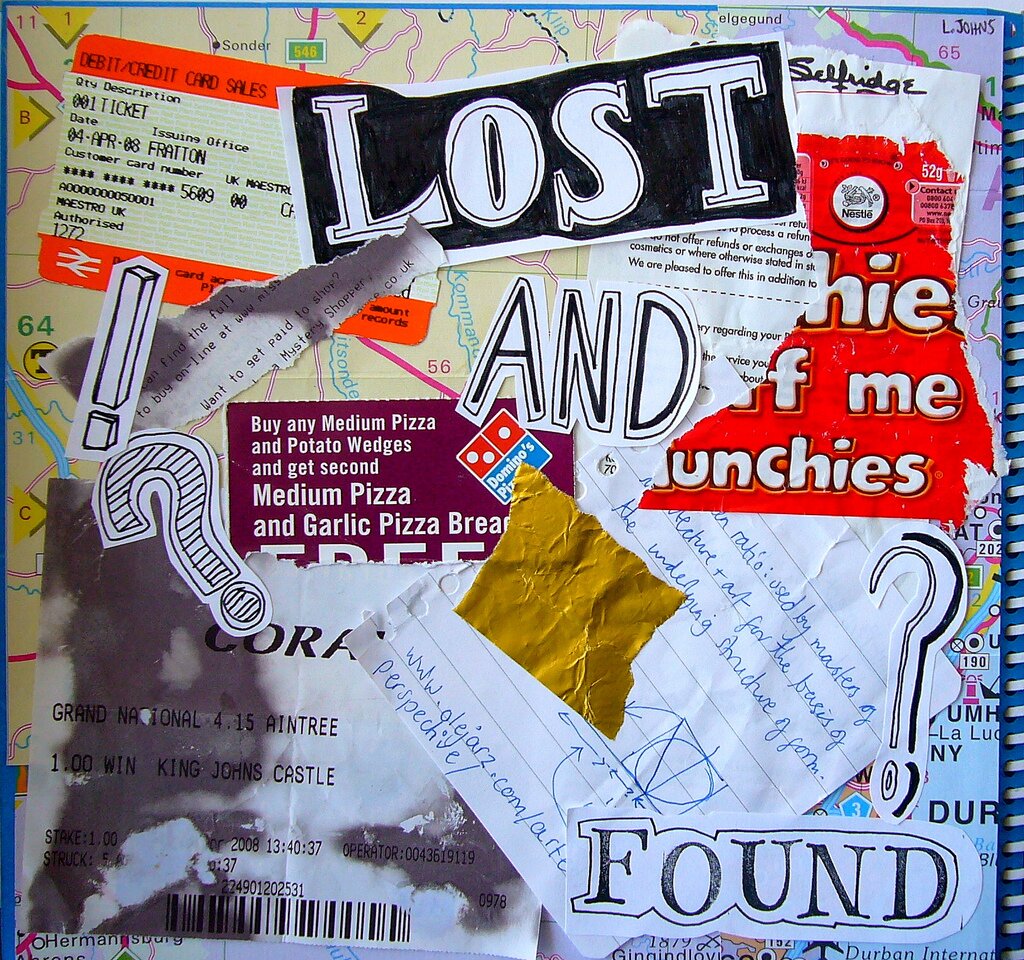
Most definitions of found poetry – sometimes called erasure poetry or blackout poetry –  employ a collage metaphor to describe how poets cut out words and phrases from texts and stick them together to create something new.

Invoking safety scissors and glue stick projects gets the basic mechanics across, but  doesn’t do a great job of conveying found poetry’s intentionality and art. My favorite description comes from Annie Dillard’s introduction to her collection of found poems, MORNINGS LIKE THESE:

Those happy poets who write found poetry go pawing through popular culture like sculptors on trash heaps. They hold and wave aloft usable artifacts and fragments: jingles and ad copy, menus and broadcasts — all objet trouvés, the literary equivalents of Warhol’s Campbell’s soup cans and Duchamp’s bicycle. By entering a found text as a poem, the poet doubles its context. The original meaning remains intact, but now it swings between two poles. The poet adds, or at any rate, increases the elements of delight. This is an urban, youthful, ironic, cruising kind of poetry.

Not only does Dillard’s definition provide a clearer picture of both found poetry and the people who write it, but it also gives us a better understanding of its detractors. Editors who will inevitably cry “plagiarism!” and “unoriginal!” are but a few branches down the family tree from the conservative art critics who turned up their noses at readymade and pop art in the mid-twentieth century.


Finding a Good Poem

© Jake Bouma.


Imposing parameters or restrictions on experimental writing like found poetry is usually considered bad form; however, working on the The Found Poetry Review has forced me to make decisions about what I consider a quality poem.

I’d put the types of submissions we receive into three broad buckets:

1.     Reportage: These pieces excerpt sequential lines from a source text, with the primary intervention being the addition of line breaks or spaces. Photographs of juxtaposed signs or graffiti also fall into this group.

2.     Distillation: Poems in this category take words and phrases from a source text, rearranging them into a final piece that retains the text’s general message but is arranged in a new way.

3.     Reinvention: Submissions falling into this group take words and phrases from a text, but arrange them in ways so that the poem’s meaning has little or nothing to do with that of the source material.

Most of the poems we accept at The Found Poetry Review come from the second and third groups. When evaluating traditional poetry, editors look for originality in words and sentiment; in found poetry, I look for originality in arrangement. What can you add to the source material? What new story can you find within the original?

Poems from the first group are problematic for me, both as an editor and a writer of found poetry. Singling out a pithy paragraph in Lolita, pressing the return key a few times and calling it a found poem doesn’t do much for me on the editorial front – it’s not surprising or inventive. More significantly, as someone who writes found poetry and tries to build a case for it’s value and art, I see these “reportage” poems as walking too fine a line between plagiarism and ingenuity.


Where to Begin: Crafting Your First Found Poem

Because found poetry is experimental and so individual, I encourage curious writers to jump in first and read examples from the field later. You need to play around before you can get serious.

Since you’re presumably reading this post on the Internet, Wave Books’ erasure tool is a great place to start digging. There, you can choose one of 20 source materials to work with, then use an interactive tool to click and erase words from the text until you arrive at a final poem.

When working electronically from a web-based source (Project Gutenberg, with it’s wealth of public domain source texts, is a good place to begin), you can also consider pulling up two windows side by side – one with your source text and the other with a blank Word document. Skim through the text quickly, copying over into the document interesting words and phrases. Condense and reorder those snippets to create your found poem.

Offline, approach any text – from your morning newspaper to your favorite book to your pile of junk mail – with a pen in hand. As you read, underline or circle words and phrases, then try to work them into a poem. You also have permission to get out those scissors I referenced at the beginning of this post – cut up texts into strips, mix them up and then physically rearrange them on a board or table.

Enlarge Your Practice by Learning from Others
After you’ve taken some time to play around and understand your natural instincts when it comes to writing found poetry, take the time to read what others are doing in the field. Seeing how other writers approach the same art form – and perhaps even the same texts – will help you enlarge your practice.


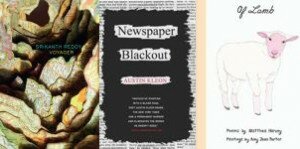
Below is a short list of some published works of found poetry to buy online or request from your local library:

Online journals such as The Found Poetry Review and Verbatim Poetry also feature plenty of examples from other poets that may spark an idea for your own work.

Finally, be sure to let others learn from you. Post your found poetry on your blog or website, introduce it to your writing group and submit your works to online journals for publication. If you’re a teacher, try a found poetry exercise with your class.

If you’ve written found poetry or have favorite pieces from others to share, be sure to post the text or a link in the comments section below!


Jenni B. Baker.

Jenni B. Baker is the founder and editor-in-chief of the Found Poetry Review. Her poetry has appeared in over a dozen publications, including InDigest Magazine, The Newport Review, qarrtisiluni and BluePrintReview. She is currently working on a manuscript of found poetry derived from David Foster Wallace’s Infinite Jest, titled Fest.

 

By Chris Giles of My Beautiful Paintings

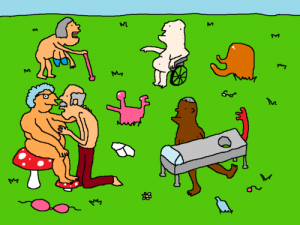
Geriatric Sex Garden

I sized up his pink apparatus
under the flood moon light.
He grinned like a diamond
and gave like a gift.
Though white hair cools wind
and I live like my mother,
I’m young in the lather of night.

Helen Harvey, 9th April 2006


Click here if you suck

Screnzy

April is to poets as November is to novelists. And while NaNoWriMo’s Office of Letters and Light urges writers everywhere to indulge in a so-called “Script Frenzy” this April, I’ve always preferred the mellower drug of poetry.

NaPoWriMo: 30 days, 30 poems. I first heard of NaPo on April 1st 2006, and naturally I assumed it was an April fool. The idea grabbed me though, and after several hours’ agonizing over the potential humiliation I eventually decided, fool or not, it was a cool idea. I threw caution to the wind, announced my intention to friends, threw a party, got drunk (it was a Saturday night) and at midnight I sat on the windowsill and wrote a poem about getting drunk and sitting on a windowsill.


Why should I?

Because it’s fun. Because everyone has a lot of clogged up unpoetic rubbish in them trying to wriggle free as poetry. At the very least you can think of NaPo as poetic colonic irrigation.

Because sometimes you write good stuff. You write things you didn’t think you had in you. You end up looking for inspiration in the unlikeliest of places: Didcot railway station frinstance, sick puddles, motorways, aunts, Woolworths, the smell of bacon when there is no bacon.

When you write so much poetry in such a short space of time you get a chance to let go of the fear of damaging that blank white page. Liberate yourself.

Chaucer prefers to travel the old fashioned way


An Accident

I’ve stalled on the wrong side of the motorway.
Chaucer is on my bonnet, bloody.
O bugger.

20th April 2007


Writing 30 good poems is not the point.

Of the 121 poems I have ever written for NaPoWriMo (I unwisely got carried away in 2008) this is what I have achieved:

  • 8 published or soon-to-be published
  • 2 prize-winning
  • 1 Daily Deviation on deviantArt.

7.4% is, it has to be admitted, not a high rate of efficiency. But it’s not nothing either. Most of the poems I produced have potential I’ve never bothered to chase; or have provided a phrase, a thought, an image I’ve reused elsewhere. A number are in the wings, biding their time, waiting to pounce.


Seamonster’s Lament

I met a seamonster looking sorry for himself
on the High Street, and I asked
what was up.

I wanted to buy a card,
he said, from Woolworths,
for my Valentine’s date. Looks like
the wires are down between here
and the deep sea. No one told me
it was over.

This is the way the world ends, said I.

23rd April, 2009


Don’t be ashamed.

Hone your poetic muscles till they bulge from your cheesecloth smock. When you walk down the street strangers will swoon at the size of your massive creativity.

I haven’t NaPo’ed for two years, but by May 1st 2012 I intend to be a poetic gladiatrix once more. Join me.