Milkweed Editions, October 2010.

Milkweed Editions, October 2010.

For the most part, I feel like I have no idea what I’m doing. I don’t mean with poetry, or with prose, but with life. Most days, there’s a devilish beast at the bottom of my spine telling me I’ve got it all wrong. What have you done with your life? Little selfish word-eater, time-waster, navel gazing narcissist. Get a real job. Help someone. Do something. Solve problems. Grow up. But other days, especially when I’m on the road and sharing poems with strangers, I think it’s all going to work out, and that in some ways I am helping, even if just by pointing at the pain and the joy and saying “Yeah, me too. I see it, too.”

The most recent poetry tour was 1335 miles, 11 events in 8 days, and 9 total days of car travel. When traveling with 2 dear friends and poets, Adam Clay and Michael Robins, and writing a poem every day for National Poetry Month, and meeting up with other knee-deep poetry makers on the road, it does begin to feel like, well, like dropping acid. Everything feels a bit more psychedelic and nothing’s not moving or breathing or shoving itself into a poem. No abandoned cow, no unsung greasy grackle, no roadside attraction unworthy of more words. How good it is to leave your small safe room where the majority of the work gets done in quiet reflection, risk the unknown city’s welcome, risk the bloat and glutting of road-miles, and go Willy Loman some poems.

Packed and ready to go!

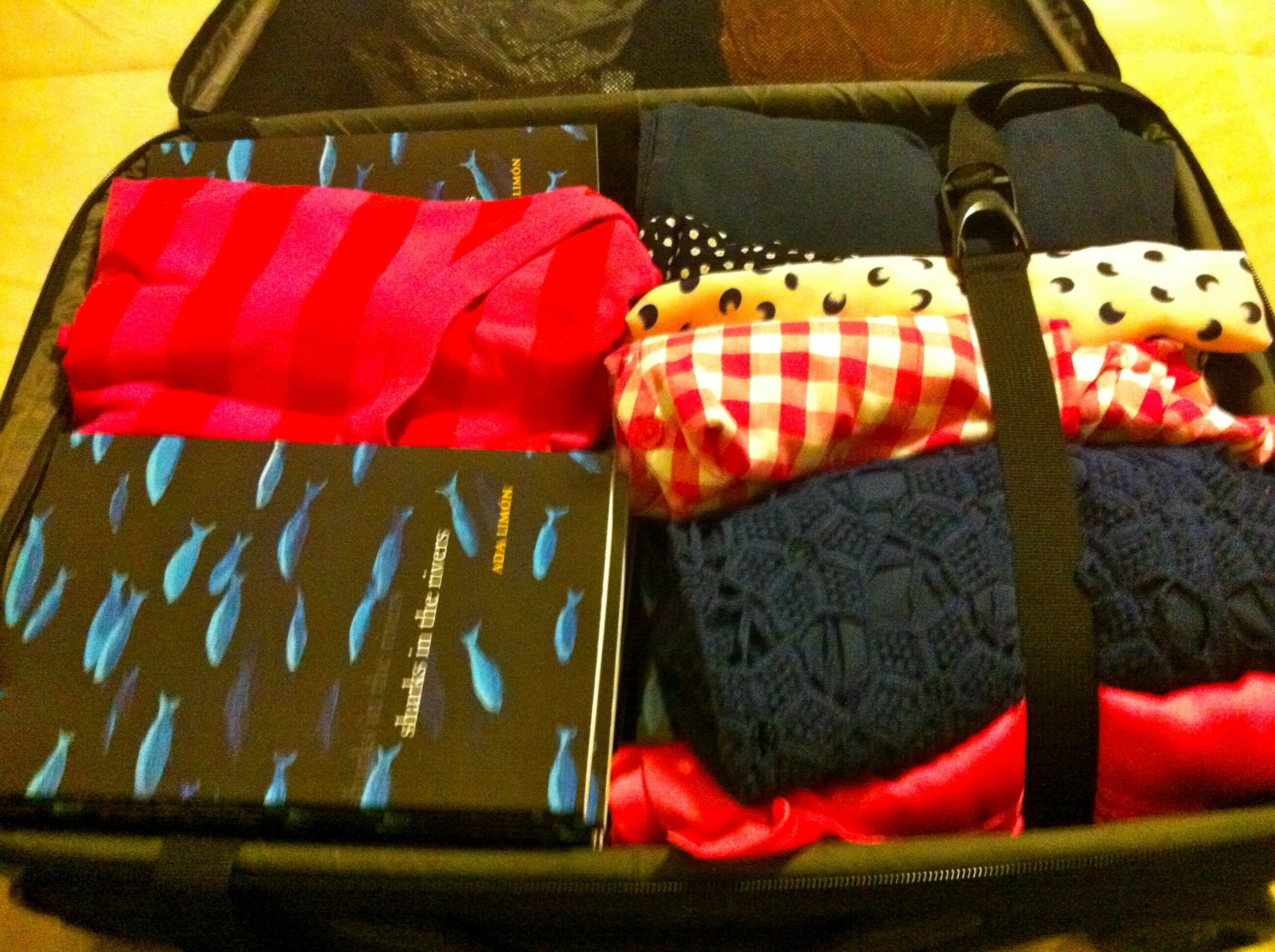
Suitcase packed with SHARKS IN THE RIVERS.

Read more…

vw84cover_largeQ: Voiceworks published your poem ‘Darlings’ in issue #84 PULP. How did you find the process?

I was so thrilled to see ‘Darling’ find its first home in ‘PULP’. That issue was published a little while before my 25th birthday, so I was almost but not quite too old to be sending poems to Voiceworks! As for the process, Voiceworks is very hands on, and I so admire the time and energy the editors put into their writers’ work, especially young and emerging writers. On the other hand, I’m inclined to feel that work should be accepted or not accept as is; that there’s something sort of tricky about accepting a piece of writing conditionally, with suggested edits, especially where such edits are extensive or significant. I suppose this depends on the writer and their experiences, and whether they’re looking for feedback, or to workshop what they’ve written. And honestly, who doesn’t love a reader—someone who will read your work closely and offer a detailed response of some sort? That Voiceworks also offers feedback to both successful and unsuccessful contributors is something else I really appreciate.

Snowline coverQ: You’ve just released your debut collection Snowline with Whitmore Press, congratulations! What did you do when you realised you would be 2012′s feature poet?

Thank you! Although I wasn’t 2012’s ‘feature poet’ as such — I was actually joint winner of the manuscript prize with Queensland poet B. R. Dionysius, whose collection is Bowra.In 2012 Whitmore Press also put out a chapbook by Luke Beesley, Balance, which is just stunning (and not only for its bright, lime jelly-green cover, which is so ace in itself!)—as well as a new full-length collection, Available Light by Graeme Kinross-Smith.

As for winning the prize, I was so thrilled just to make the shortlist, especially alongside so many amazing (and often-widely published) poets, whose work I admire. The email announcing the joint-winners came through quite late, from memory, but happily my partner lives not far from a bottle-o that seems to be open all hours, so we walked there to pick up a late celebratory drink. Most likely a bottle of cheap red wine.

Q: How does publishing your first collection feel? Does it change the way you see your creative work now?

It feels pretty surreal. Seeing and holding the chapbook was the first strange thing, and then knowing that people were reading the poems was even stranger; I’d only recently—in the last couple of years—started to try and publish my writing in a few journals here and there, so I was still very nervous about the whole thing. For a long time I didn’t know the opportunities that were out there, but what I was writing then wasn’t really publishable anyway.

I’m not sure if it changes the way I see my creative work, really, because I’m always quite self-critical. I also tend to want to put the things I’ve done behind me and move on to the next thing. But on the other hand, yes, of course it does—the prize and publication of Snowline were of course so validating, and also, for me, kind of terrifying.

I also feel very fortunate that Snowline has been reviewed a few times, less than a year on; I don’t know how much attention a chapbook usually gets, by comparison to a full-length collection, but I guess I thought I’d be lucky if it got just one little mention somewhere. As far as I know, though, it’s up to three reviews, and possibly a fourth coming up online, a bit later in the year. The first was in Metre Maids, with another in the September issue of the Australian Book Review, and a ‘review short’ over at Cordite.

Each one has been so positive and generous, which of course is validating again; and sort of surprising, too—part of me was so nervous somebody was going to say, ‘why’d they pick her?!’ So it’s been excitement filled with anxiety, but that’s probably not the worst thing. I tend to think self-doubt can often be quite useful.

Q: In reading Snowline there are continual motifs of returning, shifting from awake to asleep and landscapes that evoke nostalgia. What other concrete topics surface when writing? What are you naturally drawn to?

You know, I was only vaguely aware of these recurrences and patterns before, because to begin with I was writing the poems as individual pieces, without a collection in mind. I never thought I’d be putting together a manuscript—or not any time soon—but then when it came to choosing and ordering the poems for Snowline, I started to see the repetitions in another way, and started to think about them a bit more self-consciously. Maria Takolander, who launched the collection in May 2012, counted a few of them; I think human wrists appeared six times, for example.

So I suppose I’m naturally drawn to certain images, such as wrists and snow and glass and dreams, and also to memories made material and tangible. Having said that though, such memories aren’t necessarily personal autobiographical as such, especially not the later or more recent poems; I think it’s the image or the scene I’m drawn back to. Months after Snowline was published, it was a very warm spring; my neighbours’ magnolia trees were flowering like crazy, and I live close to Geelong’s Eastern Beach, but I was still writing poems about snow, about wintery Austrian landscapes. So perhaps that says something about nostalgia too, and the way that memories or remembered spaces resurface and repeat.

smallwhitmorelogo1Q: Clue us in to what the editorial process with Whitmore Press was like?

It was really wonderful. Anthony Lynch (my Whitmore Press publisher) is great—I really respect him as a poet, short story writer and critic, as well as an editor, and really valued working with him on Snowline.

Q: The poems ‘Rabbit’ and ‘Garlic’ are side by side, was this intentional?

Well, yes, but not in any meat and garnish kind of sense, if that’s what you’re suggesting! The ordering of the manuscript was decided over loose sheets of paper, spread out over my floor at home and shuffled around, again and again. ‘Rabbit’ and ‘Garlic’ weren’t intended as a pair as such, but I guess at the time I thought they would make good neighbours.

Q: Which poem were you most attached and why?

The answer to this question is always changing. Sometimes the poems I think don’t really ‘fit’ the collection, or the ones I’m not as fond of, are those people mention to me, or the pieces reviewers have cited (in a positive way). I must be very impressionable, because then I feel quite proud of—or at least okay about—that particular poem again.

I’m sure every writer feels his or her work change and develop, and it’s not such much that I think this or that piece is completely terrible, but more that some of them feel quite long ago, even if they’re not. It’s a sort of distancing effect, and maybe a feeling of ‘I don’t think I really write like that anymore’.

Q: Currently, what collection or poet/poem has you under its spell? What do you think we should be reading?

With poetry—and in fact, probably with other genres of writing too—I tend to be reading a few different things at once. New work by Australian writers, in various journals and magazines, is usually what sends me looking for full collections. Claire Potter’s Swallow was released a little while ago now, but it’s one I’m often returning to, and I’ve been excited to find new poems of hers here and there.

At the moment I’m also making my way through a borrowed copy of a Roy Fisher collection, and especially love a prose poem sequence called ‘Metamorphoses’, which is full of such spare yet beautiful images.

forrest300I was given Veronica Forrest-Thomson’s Collected Poems for Christmas, which very much has me under its spell—I fall for a new poem of hers each time I revisit the collection, and most recently my favourites are ‘For the Spider who Frequents Our Bath’ and ‘A Reaction to Rings’.

Another gift, a kind of hand-me-down present actually, is a book Roy Fisher’s poems. There’s
a poem in that collection I love, which is short enough to cite in full (I have a bit of a thing for
short poems, and this one is a particular favourite):

A WHITE CITY

My thoughts turn south
a white city
we will wake in one another’s arms.
I wake
and hear the steam pipe knock
like a metal heart
and find it has snowed.

And then there are a few single poems I seek out in collections and anthologies, to read again and again. Barrett Reid’s ‘The Absent Heart’ is a beautiful and devastating poem, and one I go searching for quite often. It’s in a book called Making Country, which I should probably read in full, but each time I open it, ‘The Absent Heart’ is the poem I seek out.

Q: What’s your favourite space to write in?

I’m pretty pragmatic, and I write when and where I can, which is usually at home. I don’t have a desk, but there’s a round dining table by some big windows that let in a lot of sun and overlook the street, and that space usually does the job nicely. I love to read in the bath, too, but for writing it’s pretty impractical.

Q: Can you let us in on any secret projects, or not so secret things you’re up to?

I’m a bit hopeless at keeping my own secrets – and luckily, with writing at least, I don’t have many. My biggest project at the moment is my doctoral thesis, which I’m undertaking at Deakin University. Part of that involves working on a creative artefact, which for my project is a work of fiction. I’m not very good at talking about it yet; maybe ask me for a better description (or synopsis, even) once it’s finished. The dissertation, however, is looking at elegy, melancholia and representations of trauma in magical realist literature.

Q: Will we be seeing Jo Langdon stamped onto collections in the future?

I certainly hope so, but who knows?


joJo Langdon is the author of a chapbook of poems titled Snowline (Whitmore Press, 2012). She is currently a PhD candidate at Deakin University, where she also teaches literary studies and professional and creative writing.

springtbh_905


STACEY: Hi Lucy, thanks for agreeing to answer some q’s. You run an online lit journal called Shabby Doll House, do you want to tell us a little bit about that?

SHABBY DOLL HOUSE: Hi Stacey.

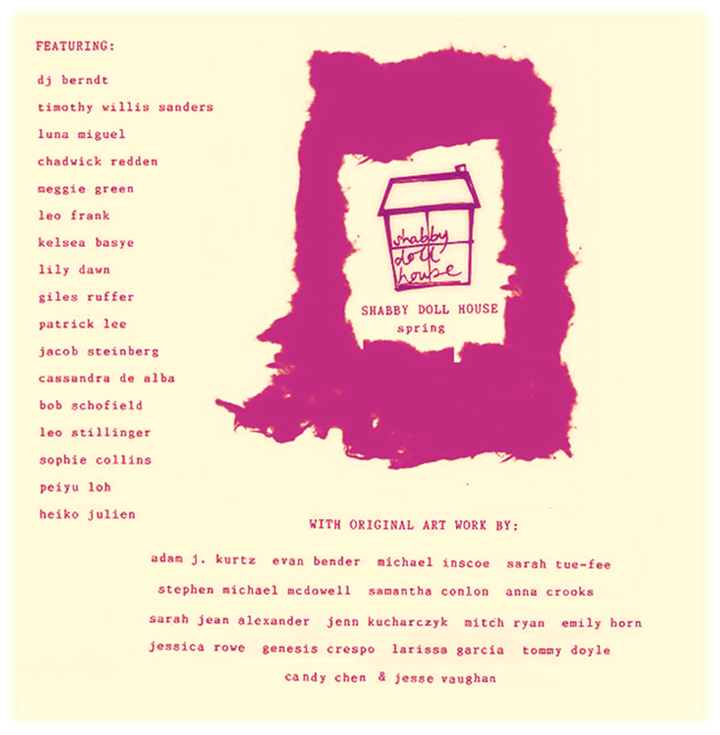
Shabby Doll House (est. 2012) is an online publication that I started in order to showcase work that I felt excited about, but that didn’t seem to have a home. We publish various forms of literature alongside original visual artworks made specifically to accompany the writing. We have published short stories, poetry, tweet compilations, gchats, watercolour paintings, .gifs, photographs, collages… It is kind of a mix of everything, but I think it has developed a particular style and sense of aesthetic.


I edit the website with Sarah Jean Alexander, and we aim to curate a cohesive collection of work every quarter. The general theme or aim, I think, is to distract or prevent people from feeling lonely.


S: Seems like a good thing for a online publication to want to achieve. What is the submission process like and roughly how many pieces would you get for every issue? Are there particular things you look for when selecting?

SDH: We received around 150 submissions for the last issue and published 17 of them, so we are able to be pretty selective, which is nice. I feel really good about all of the work we have published so far.

I don’t think I can articulate what we’re looking for exactly, other than to say I’m attracted to things that feel honest/funny/sad/new/comforting to me, maybe… Generally, I just seem to know straight away if something is a good match.

I’d recommend that people wanting to submit should read the site and then send whatever feels right/real/exciting to them. I’m interested in finding innovative ways to tell stories. Interested in not feeling bored. Interested in being shocked by the possibilities of poetry… I want what we’re doing to continue evolving. I want people to us send things that they feel nervous about.

S: Another thing I have noticed with regards to Shabby Doll House is the way you seem to ‘nurture’ your current and past contributors. If you look at your tumblr, Facebook or twitter, you are always re-posting things related to people involved with SDH, I guess in the same vein as Pop Serial. You also do a ‘news roundup’ type thing. Did you start doing this intuitively and do you think it makes your publication stronger in any way?

SBH: Nice. I’m happy that you think that. I think it’s intuitive to a certain point and then I try to go beyond that and to think of different ways that we can support people’s work. I definitely want there to be a sense of community about Shabby Doll House, and I want to be able to give our contributors a platform to find a larger or different audience for their work, once we’ve published them.

But also, I think it’s a cyclical thing, because every time we publish a new person, we are introduced to their circle of friends etc. Everybody is sort of helping each other. I’m just excited that all of these people are alive at the same time as me and that, thanks to the internet, we can now work together so easily. We’re incredibly lucky in that sense. It is easier than it ever has been to find other people who are like you.

S: What is your/Shabby Doll House’s relationship with “alt lit”?

SDH: Kind of feels like being associated with alt lit is like having a brother that you don’t really get along with, because everything he says seems insane and makes you feel embarrassed, but if anybody outside of your family insults him, you feel defensive and want to protect him because he’s still your family, or something…

S: I used to feel more negatively about alt lit than I do now. I feel more open to it, and think that there are good things happening within it, you just have to pick out what you like and leave the rest. More than anything I think that alt lit is a place for people to come together, like what you were saying about community, I think it is a nice thing to have that kind of support system as a writer. How do you think being a part of “alt lit” (is it okay that I am putting it in scare quotes?) affects your writing?

SDH: I appreciate the lack of pretense,  I like that people don’t feel the need to dress their emotions up in literary devices. I think that’s what I feel most excited about and affected by in relation to my writing.

I think there is more to it than that though. I feel very fortunate to be part of a group of writers who work hard and support each other, and I feel encouraged by the responses I get from them. I think I’m more productive because I’m part of something that’s bigger than just me. I feel like I’ve met people who want to do the same things that I want to do, for the first time in my life probably, so as much as it is easy to complain about a lot of things within ‘the community’, I think we’re all extremely lucky to have collided somehow.

When you look at how people’s closest friends are scattered around the whole world, you can understand the extent to which these people need each other. I think it’s going to be interesting to see what happens to ‘it’ and to everybody, as time goes on/things develop.

S: Yeah, I feel interested in that also. It’s nice to feel like you will always have an audience, particularly because that audience happen to be your friends. What does the future have in store for Shabby Doll House?

SDH: We will do three more issues this year, and there are going to be a bunch of readings in the summer time in the US and Canada. Also we’re going to be putting together a print book in the fall with new content from some of our past contributors, so that’s something I’m really looking forward to.


You can read past issues of Shabby Doll House here (http://shabbydollhouse.com/) and you can contribute by emailing shabbydollsubmissions@gmail.com


907030_10151605141308615_1865501815_n

Stacey Teague’s fave types of nuts are almonds, pistachios and cashews. Least fave are brazil nuts and walnuts. Blogs at staceyteague.tumblr.com

I’m going to celebrate National Poetry Month by having an argument with a 94-year-old-man.

In his 2001 poem “Challenges to Young Poets,” Lawrence Ferlinghetti (born 1919) says “To be a poet at sixteen is to be sixteen; to be a poet at forty is to be a poet.” (He’s probably referencing the 19th century artist Eugene Delacroix, who said something similar.)

Jessy Randall.

Jessy Randall.

I disagree. I think to be a poet at sixteen is to be a poet, and to be a poet at forty is to be a poet. But I do agree that most teenage poets do not stay poets, and I lament that.

When I was in high school I knew many great poets. I was in class with them. I saw them every day. I read their poems every week. I knew they were much better than I was. I KNEW it, objectively. (In college I would argue against the idea of objective quality as hard as I argued for it in high school, but that’s another story.)

Everyone wrote poetry then. Some people hid it more than others, but I was an editor of the high school literary magazine and I’m telling you, EVERYONE wrote poetry. Even the people you would least suspect.

But then, somewhere along the line, they all stopped (except me). I wish they hadn’t. They were so good! I would like to read what they would have written, if they’d kept on writing.

I don’t usually try to defend poetry or say that it helps the world. I’m usually not certain that poetry does anything except make me (and some other people) occasionally happy or sad or some other emotion. This week, however, I read a poem that made me think poetry might serve a larger function.

After the bombs went off at the Boston Marathon, everyone around me (physically and virtually) was upset and didn’t know what to say or do. We mostly threw up our hands. Maybe we reached out to each other a little bit, but mostly we threw up our hands, as we do after school shootings (see this article in The Onion).

Poet Scott Poole, however, wrote a poem. I know Scott a little bit. We read together last year in Spokane, Washington. I’m a huge fan. He is hilarious. Not this time, though. Here’s the poem he shared on Facebook: Read more…

I have been writing things since I was very little but I have only been keeping them in designated places (as opposed to collections of scraps) for a few years. Over the past five years I have been using mostly the same kinds of notebook to keep my ideas and writing and objects in. Usually my drafts don’t begin as such in the notebook, but the process of collection images or assembling my thoughts, working out my ideas and arguments happens there. The notebooks are the armature for the poem or piece of prose that will come later.

My thought is to show some of the process. I write poems and longer prose things. I read them, too. I find myself sometimes overwhelmed by the completeness of the world. Meaning, first, everything seems already to have been done, and second, that everyone else working now seems already to have finished their work while mine feels perpetually just-begun.

I think this is in part because what I privately (and not very usefully to my writing sometimes) think of as capital-L-Literature is what is finished, vetted, authorized, paid-for. And most of what I make is not these things. So for my post here for Poetry Month, what I offer is a selection, both transcribed and photographed, of pages and fragments from my notebooks. These are where my writing comes from. Which isn’t to say what gets written here becomes the writing. I write things down, glue things in these notebooks. Later, sometimes, I come back to them like I would to notes for a paper or an exam.


(I was reading a friend's manuscript to offer a critique. Those notes are on the top left side: “Sarah's poems: caves/depth/rot-softness-not necessarily a positive attribute/ears, disjointed body/insides of things/dankness/mineral/telephone/[illegible]/animal”. Below that, a to-do list and “now we are/ old enough/we know/we can die”. On the right-hand side of the page, some drawings and to-do lists.)

(I was reading a friend’s manuscript to offer a critique. Those notes are on the top left side: “Sarah’s poems: caves/depth/rot-softness-not necessarily a positive attribute/ears, disjointed body/insides of things/dankness/mineral/telephone/[illegible]/animal”. Below that, a to-do list and “now we are/ old enough/we know/we can die”. On the right-hand side of the page, some drawings and to-do lists.)


(From a very recent notebook. The far left page: part of the novel I am working on [“Approaching Naples in a...]. The page that is vertical looks like reading notes of some kind. On the right-hand page, working out plot or connections between elements in the novel. Middle of the page: “socialization for subservience | 1619” [I am not sure any more what that date means there] and then below that “getting to know dates the way/some writers know characters/ the century”.)

(From a very recent notebook. The far left page: part of the novel I am working on [“Approaching Naples in a...]. The page that is vertical looks like reading notes of some kind. On the right-hand page, working out plot or connections between elements in the novel. Middle of the page: “socialization for subservience | 1619” [I am not sure any more what that date means there] and then below that “getting to know dates the way/some writers know characters/ the century”.)


(From a notebook from February 2010, some to-do lists. In the middle of the page, “START WHERE/YOU ARE//USE WHAT/YOU HAVE” and a fragment of a poem, “we wanted both honeybees/and cheap, instant/connection to home//we wanted to migrate/with no pain”. Bottom left, “Who appointed you arbitrator of what I (can) know?”.) Background = my current notebook.

(From a notebook from February 2010, some to-do lists. In the middle of the page, “START WHERE/YOU ARE//USE WHAT/YOU HAVE” and a fragment of a poem, “we wanted both honeybees/and cheap, instant/connection to home//we wanted to migrate/with no pain”. Bottom left, “Who appointed you arbitrator of what I (can) know?”.) Background = my current notebook.


(A page from the notebook I used up until we left England to live in Belgium, where I collected pieces of plants I saw daily. I wanted to remember the English landscape I lived in very precisely. At top left, with arrow: “First snowdrop, 2012, Jan. 9”.)

(A page from the notebook I used up until we left England to live in Belgium, where I collected pieces of plants I saw daily. I wanted to remember the English landscape I lived in very precisely. At top left, with arrow: “First snowdrop, 2012, Jan. 9”.)


(The notebook I am using now. I sometimes find the squares hard to write on, somehow constricting. This is me working out where things might go in the novel I am working on. From top down: “APRIL—STILL//[Public Record] 3480// [Film Stills/inside tsunami] 823// [FIRST THINGS FIRST] 536//[LiST of SURViVoRS] 1819// [SNOW] 1492 // [AFTER QUAKE/ON ROAD] // [Blandinsky?] 3097 // [MODES OF COUNTING] 2231 // [SHe sees HIM] 189 // [DEATH CERTIFICATES] 1191 // [B'sky?] // [Book of Beginnings] 3778 // [RAIN] 842// [Dictionary]”.)

(The notebook I am using now. I sometimes find the squares hard to write on, somehow constricting. This is me working out where things might go in the novel I am working on. From top down: “APRIL—STILL//[Public Record] 3480// [Film Stills/inside tsunami] 823// [FIRST THINGS FIRST] 536//[LiST of SURViVoRS] 1819// [SNOW] 1492 // [AFTER QUAKE/ON ROAD] // [Blandinsky?] 3097 // [MODES OF COUNTING] 2231 // [SHe sees HIM] 189 // [DEATH CERTIFICATES] 1191 // [B'sky?] // [Book of Beginnings] 3778 // [RAIN] 842// [Dictionary]”.)


Éireann Lorsung

Éireann Lorsung

Éireann Lorsung is an American writer (two books of poems, MUSIC FOR LANDING PLANES BY, Milkweed Editions 2007 and HER BOOK, Milkweed 2013; prose published in DIAGRAM, The Collagist, and Bluestem; poems in many journals). After doing her BAs and MFA in the city of her birth, she went to France to work—then to England to study some more. She now lives in Belgium, where she runs a small press and edits a magazine. She likes talking to people about writing, art, and ideas. She also likes spicy food, Singlish, cushions that look like biscuits, and the word ‘turpentine’.

VERANDAH 3 COPIES


Verandah is a literary and visual art journal published in Melbourne, Australia. Founded as a student-run publication, the first issue launched in 1986. Originally situated beneath the shade of the vast verandah’s surrounding Victoria College, a place in which the journal takes its namesake. The publication puts emphasis on new and emerging writers and fosters creative talent and skill. It honours the work of Deakin University students, but also calls for submissions from across international writers and poets. The journal also gives out prizes according to category. The Matthew Rocca Poetry Prize was named after a dedicated student of Deakin, who unfortunately passed away during a year of study, his parent’s have fossilised his love of poetry within this prize.

2013 will mark its 28th year in print and editors are currently seeking submissions of short literature and poetry for publication later this year. Your closing date is June 1. We are honoured to extend this invitation to Metre Maid readers and look forward to reading your submissions. Submission fees are fed back into the publication at no profit to the University or volunteer staff.

For guidelines, check out www.deakin.edu.au/verandah

This years editors are Hayley Ryan-Elliot, Jonathan Lawrence, Kyah Horrocks, Lauren Hawkins and Leizl Bermejo


KONICA MINOLTA DIGITAL CAMERAFor a short three years of my life, my friends were poets. Maybe not all of them, but the ones who weren’t poets were essayists or novelists, and poetry wasn’t a bad word among us. We all read poetry, went to readings, talked about this new writer or that piece, wrote poems or stories or both. We also bitched about our bosses, celebrated each other’s birthdays, went jogging when the weather lifted above freezing and we felt we’d maybe run out of things to write. We drank, ate, fucked, sometimes danced, went to the movies, gossiped, despaired, told dirty jokes, congratulated one another on our small successes, envied each other the same, talked about our families, caught and missed buses—in other words, we lived our lives like everyone else. Then we all finished grad school and, with MFAs in hand, moved toward the compass point that promised the most luck or the least terror.

KONICA MINOLTA DIGITAL CAMERAFor me that meant moving back to Seattle where I had a paycheck waiting and friends I’d left behind. Though the job I was coming back to had nothing to do with writing, at least I had a job in a time when economic uncertainty was becoming the norm. And unlike when I up and moved to Minneapolis for school, at least I was returning to a city that wasn’t an unknown. It was comforting to come back to a place I knew, to people I knew.

Actually, no—it wasn’t. Because from the first day back I realized they didn’t know me.

It wasn’t completely their fault. Even before grad school, I didn’t tell many people about my writing—I wasn’t hiding it exactly, it just didn’t seem to come up. My co-workers were more focused on whether or not that sponsor had signed on to bankroll the new website we’d already started producing or if I was going to that team morale event at the go-kart track. My friends wanted to know whether our skyscraper apartment building really was being demolished because of unsafe construction (it was), how my new old-job was going especially with that commute over the bridge getting worse, if I’d tried that recently opened restaurant that sourced all their food from no more than 360 miles away, and if I was going to so-and-so’s baby shower next weekend or you-know-who’s housewarming party. The couple of times I suggested going to a reading, everyone feigned a bit of enthusiasm; nobody showed.

McGuireAptsDemolitionWhen the layoff rumors came true and I no longer had a corporate job neatly summed up on a business card with a recognizable company logo, I decided to try writing full time—at least until my savings ran out or my husband decided that being the sole breadwinner was overrated. But when people I met asked what I did for work, I was reluctant—no, I was loathe to say, “I’m a poet.” Based on the few times I’d tried answering that way, I knew that whatever fanciful ideas were conjured in their heads about what being a “poet” was, it wasn’t remotely close to the reality of it. So I’d say I was a “writer” and then rush off before they could ask what I wrote. I could have gently corrected their misunderstandings about peasant blouses, love and sunsets, end-rhymes centered down the page, the tears of orphans mixed into our ink wells, but I guess I was tired of doing that. Or maybe I was out of practice after the three years I’d spent not having to explain. Or maybe I felt that even if I tried, even when I tried, it didn’t change anything. It didn’t stop them from telling me how they, too, wrote poetry when they were feeling sad or from abruptly proclaiming, “ ‘Two roads diverged in a wood, and I, took the one less traveled…’ ” then looking to me for some kind of consent. It didn’t prevent them from asking incredulously if people read poetry anymore or blurting out in amazement, “Wow. Really? I didn’t know that still existed!”

The truth was, neither did I. Read more…
1-8e10fa5ef2

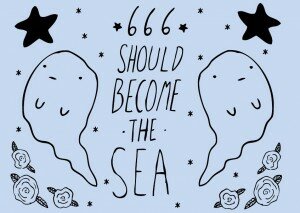
Illustration Cover by Hannah FantanAt first glance this collection reminds me of the way MTC CRONIN accounts for each image, the way one might do so with a list, or taking stock of an item. It’s kind of what I love about CRONIN and what impresses me about Christmass’ poetry. The poetry even utilises space beautifully, echoing precisely the metronome pattern of the sea. At the same time this space is precarious within its typography.

At the beginning of this self-published collection released from Scribd. The site is essentially a huge shared library where you can upload original and innovative works, accessible online or on your smart phone. There’s a keen consistency of rhythm and this undercurrent carries each line as an individual, which is very much what the players of this collection rely on. The narrative can be interpreted on different levels or perhaps an intended gathering of all aspects. The title and the way the poem expresses itself makes me think perhaps a homage to Kerouac’s, The Sea Is My Brother.

Some images that caught my eye which I loved were:

a tempest of albatross
and death
a globe beneath
surface of brine

The thing I soon realised is that 666 SHOULD BE THE SEA doesn’t let you up for air, it keeps you under like a careful and practised anesthetist  It doesn’t even give it’s subjects—the crab or the swordfish—pause or mercy. The ocean swallows everything.

666, the enigma of numerical evil represents unknowns. The sea overtakes the highway and Christmass does well in this transition of the sea (the natural) to apocalyptic (the unknown). There’s no sense of panic in this shift, the directions are soft and kind ‘Let the sea in’ almost like a chant. As readers and witnesses we become the sea and the poem proclaims ‘Become the sea, and so become idealess’. Drawing imagery from lines and curves, ‘hooks’, ‘nets’ and put up against an altered nature: ‘symmetrical fish’. The poem tells us to try not to drown, when the odds are against us.

The great thing about this collection is that you can read the first column straight down its margin or you can read across the line. This gives us a two for one kind of bonus and is an exceptional feat in terms of how difficult that kind of thing is to pull.

This poem is mad. It gets mad with the way its been such a glutton: ‘the swell, the hairy-tailed current of the towering / ocean drift’. Read more…

On Metre Maids in 2012 we celebrated some awesome poets, collections and resources. It was a great first year for the blog, and although it slowed at the end, we’re prepping for a big 2013. Keep your eyes peeled.

Cloud of Ink by L. S. Klatt released in 2011 by University of Iowa Press gives in and shares its secrets with us. This collection knows shape and precision, is evocative in imagery and narrative. On the surface, these poems are clever and spirited, but delving deeper below surface reveals darker places.

‘Fieldstones marks the graves
but our names are not engraved. Horses loosed in the field;
their bliss defends against horseflies which seem like
blackberries with wings. A tree
grows where there once was a rudder; the tailpiece
that crash-landed.’

Injecting Dreams into Cows by Jessy Randall released in 2012 by Red Hen Press. What I love about Randall’s collection is the ability to shift to and fro, from hilarious to the personal, to quaint, etc. What I also love about this collection, is the first poem ‘Metaphor’ is an absolute killer, like that one opening line that just gets your poetic pulse going: Read more…

burning rice by Eileen Chong | Australian Poetry 2012
This post first appeared on Virgule.

burning rice is part of the 2012 New Voices series and the debut collection from Eileen Chong. The publication is a sleek, pocket-size 40 pages. Here lies great poetry, tight phrasing and an innate way of telling stories. The title evokes a nostalgic sense of home and food; the notion of absence circulates the poems, reminiscent of scents and fragrances. What strikes me first is Chong’s ability to immerse the reader in two landscapes: the old and the present and this imagery is unswerving, charming and utterly absorbing. Think the sacredness of bathhouses, mooncakes and photo albums braided with beautiful descriptions of quiet and reflected moments. In any other context, these glimpses could have been mundane but here they’re given breath.

The poetry feels like walking through a family home, all those details, ornaments with stories behind them. There’s a familiarity in reading these poems, despite the cultural difference. In ‘Before Dawn’, Chong textually dedicates the poem to her grandfather with wonderful use of language, shifting to present from passing: ‘Father of my father, I was not quite seven / when you died. We drove in darkness / before dawn broke’. In ‘My Hakka Grandmother’ there’s the lines ‘run / through the fields, feet unbound /’ and ‘rice husks, like your dark hair’ evocative of childhood and that memory of food and love combined. This poem describes well the borders of otherness, specifically in ‘I wonder where our bloodline begins. / We are guest people /’. In ‘Kelong’ Chong reminiscences 1980 via the use of photography, the imagery is haunting in ‘He holds the ghost / of a fishing line but has caught nothing’ and ‘my grandmother steams / the orange fish in a wok, when you grandfather picks out / its eyes with his chopsticks’. Like Chong, I can also taste ‘the sweet flesh’ and the poem conjures up a cinematic photograph that I hold in my mind. Read more…