I couldn’t read until I was 9 years old, I stared at the words and imagined all sorts of things, longingly filling in the blanks for myself. I pretended to read out loud, I loved the sound of words and how it felt when I was telling a story, but the idea of words was something I only ever enjoyed in private, in places where there were no consequences. School was a treacherous place, and words were hostile, they humiliated me, they played cruel tricks. At the age of nine, after weeks of unsuccessfully tackling the classic b and d problem (confusing one for the other that is), in a fit of intense frustration, I marched up to the white board in front of my entire class and wrote ‘Amy is dumb’, or that’s what I meant to write, what I had in fact written was ‘Amy is bum’. There was of course much laughter, the creation of a new nick name ‘Nunn bum’ and an ongoing practical joke involving a peanut butter sandwich left on my chair. Okay so not my finest moment, but one that began a strange and significant chain of events. This was the moment I quietly promised myself to get even one day, to use the enemy’s weapons against them, wreak havoc, to show them all.

At the age of 12 I moved with my family to Australia, where unfortunately dyslexia is barely recognised within the education system. I was put into a ‘special needs’ class with children who had severe mental disabilities, and spent my days feeling utterly lost, isolated and deeply ashamed. After a few years of my mother pleading with teachers and doing everything in her power to bend a very rigid system, it eventually became clear that my best option was to live with my father back in London for a trial period, where I could attend a dyslexic school.

Being accepted into this dyslexic school felt kind of like being accepted into Hogwarts, except that it was the size of a postage stamp with a student population of about 80, and looked like the Berlin wall, post 1989. No one could speak to snakes or fly, but the students did have special abilities, things they were exceptionally good at that might have gone completely unnoticed somewhere else. One student who had trouble spelling his name at 14, could play Mozart by ear and have a basic understanding of almost any instrument handed to him within the space of a music lesson. Another student, who is now an actor, learnt all his lines in our school play by listening to them recorded on a Dictaphone by our drama teacher. Our headmaster lead yoga classes before exams and quoted the red hot chilli peppers in assembly, my English teacher had numerical dyslexia and barely knew her 5x’s tables. I felt as though i’d discovered an island of lost toys, we were part of a clan, and it didn’t matter that we’d been rejected in the past, because now we were wanted. There was nothing wrong with us, and maybe there never had been.

The occasional jeering from other schools on the way home (not helped by the words ‘dyslexics can achieve’ sewn onto our jumpers in lime green) seemed like a fair toll for this sanctuary. It was there that I learnt not to implode every time I made a mistake, to laugh with myself and not at myself, I found friends who’d all experienced some version of my humiliation at their previous schools (some much, much worse!) and I had teachers who recognised me as an individual, not a bad grade. Of course this institution, like all institutions was not without its problems, but I don’t feel I’m exaggerating when I say that in many ways, it saved me. Perhaps most significantly,  It was also here that I began to write. I didn’t know it was poetry at first, I didn’t really care what it was, only that for the first time it wasn’t about being right, it was about being free. My English teacher leant me books of poetry, Stevie Smith and Dylan Thomas were among the first, then Carl Sandberg and Gertrude Stein, Walt Whitman and Sylvia Plath. The words petrified me but not in the same way the had before, they were alive in my stomach, they meant business. I read more and more, suddenly I was hungry, scribbling in note books every chance I got, I began discovering language in a way I had never thought possible for myself. This was when it first occurred to me, something I’d always considered a hindrance, could in fact be a help.

Happy accidents are all around us, and are bountiful if not fundamental when it comes to the arts. Man Ray (once described as ‘the great poet of the dark room’) and Lee Miller discovered the technique of solarisation when a rat ran across the dark room floor and Miller flicked the light on in a panic. There is a deep intellectual fear of wrongness, of being humiliated by your own limitations or your inability to dazzle the world. We freeze, become hostile and rigid. This is the death of creativity, and of our vulnerability, without which genuine creativity would be impossible. Mistakes can also lead us to something infinitely more wonderful, they can lead us to our gifts, remind us why it is we love what we do.

I can’t help but wonder, had I not been told I was wrong so often, would I have been compelled to discover my own language, or been interested in poetry at all? Who can say, but if I’ve learnt something from my experience as a dyslexic poet it’s this, sometimes we should let them see us naked, let our poetry be bad in bed, expose the syntax cellulite and pock marked prose, put it all under the most unflattering, stark lighting available and just let it be wrong. Sometimes being wrong is so damn right.


DSC_0339


Amy May Nunn is a Melbourne based poet, she has been published in various literary journals and is currently working on her first collection.


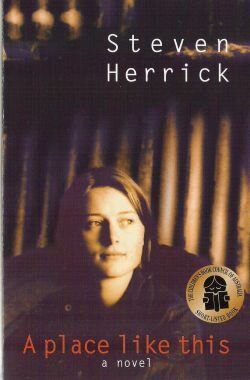
imageThere’s this book of poetry I take with me to every single poetry workshop I run. It’s Steven Herrick’s young adult poetry novella, A place like this. My mum used to buy me books sometimes – she’d give them to me after school in the car. This was one of those books. A place like this was published in 1999 by Queensland University Press. It’s the companion volume to Herrick’s other YA verse novel, Love, ghosts and nose hair, but you don’t need to know that to enjoy its story. The cover is so reminiscent of the 90’s I almost expect The Ferals were occupying the space beneath that sepia corrugated iron backdrop.

As a high school student, there where times when felt like I couldn’t write poetry because I limited myself to thinking poetry was only the rhyme and rhythm available to read and dissect in the classroom. In senior years were asked to pull apart poetry until it didn’t mean what you thought it meant anymore – until it was only techniques and metaphors you argued in essays. By year 12 I could differentiate between the poetry I was asked to practice my thinking on in the classroom, and the poetry of my home-life. Home-life poetry was the stuff I could imagine to, relate to, and marvel at the music of, because there weren’t guidelines or rubrics instructing me otherwise. Two things made this happen for me: growing up, my mum used to play Pablo Neruda’s poetry, read by celebrities including, but not limited to, Julia Roberts, Glenn Close and Madonna, on a CD on repeat in the car everywhere, all the time. It only competed with Vonda Shepherd in her basement bar with its brooding lawyers on the Ally McBeal soundtrack, and Eva Cassidy’s Songbird. By year 12, when I didn’t understand a poem, the Neruda CD taught me to read work aloud and listen to my own words. I learnt to love Margaret Atwoods Journey to the Interior – an old HSC ‘journeys’ text, that way. Also, my Mum bought me A place like this, and the book switched something on for me. Now I use it to teach students to read poetry. I work in student equity. My job is to run workshops in public high schools around New South Wales. There’s Will, who offers poetry slamming, and there’s me. The schools we visit are largely under-resourced, and relatively isolated compared to most of the educational institutes in cities. A month before I pull up in front of a school in the kind of work car I could never afford, my offices offer to English teachers at the school a list of workshops I’m able to run. There are two workshops that find themselves in the highest demand, no matter the school I visit. The first is a fiction writing workshop for year 12 students shitting themselves because, for the first time in their entire educations, its assumed they’ve been writing short stories in forty minute bursts their whole high-school career, and now it’s time to perform that skill in an exam. The other most-requested workshop is about reading poetry. I put it together when I discovered how hesitant teachers were to run poetry writing workshops with large groups, because they felt their students would disengage. I think I’m not the only student to ever struggle through the prescribed deconstruction of The Rime of the Ancient Mariner.

A place like this is about two teenagers, Jack and Annabel, deciding to take a year off after high school. On their drive to anywhere, their car breaks down and the young couple find themselves picking apples in a farmer’s – George’s – orchard. It’s when we meet George’s family: his children Emma, Beck and Craig, and we learn of their runaway mother – that Herrick begins to craft a beautiful and intense story. He invents and threads six unique voices together to create a complex poetic narrative.

Giving a group of students a poem and asking them not to think about it beyond its words and initial impressions elicits a varied reaction. Sometimes, though, pencils and highlighters drop, and there’s a groan. The groan means ‘Reading a fucking poem sounds like a terrible idea because I don’t know how to do this, and poetry sucks, and I don’t want to read more of it.’ I tell them to take their time with the poem: read it twice. Read it once at the pace they usually read, and then go back and take the writing in slowly. Sometimes I read it aloud. Sometimes, after they’ve read it silently, one of them will read it aloud.

I photocopy specific pages – confronting pages – for the students to read. The first time I read Jack and Annabel having loud sex on hay bales in a shed, it made me squirm in an awesome way. You can do this in poetry – you can make teenage shed sex sweaty and prickly and drunk and loud in a bunch of lines. This is awesome. And it is. Sometimes I don’t give students a poem about sex, though. I print a poem about Emma, a now-pregnant 16 year-old, remembering the moments after she roused from being passed out in a bed at a house party, naked, hung over, unsure and suspicious. On other occasions I’ll print a poem where she aspires to return to school after she’s had her baby. On the other side of the paper I print a monologue from Emma’s little brother, Craig, who speaks about the night his mother left the family after she had prepared dinner and Craig’s other sister, Beck, vomited all over it. I print the poems about escape, humiliation, struggle and tender underbellies – in A place like this, it’s not hard to find these poems. They bind the story of Jack and Annabel together. They make Jack and Annabel’s own euphoric hopefulness for their lives and relationship a little less real for the reader, but we also cling to it more fiercely.

Snakes are slayed, plans take detours, dads and children and strangers tell you secrets and stories and sensations, apples are picked, people get drunk. Still, despite the fleetingness of these poems, there’s this reflectiveness and intimacy the reader experiences each time a different voice emerges and lingers for a page or two. Herrick makes you forget you’re reading poetry. His short narratives – all linked by broader activity and scenario on the apple orchard – almost distract the reader from even possibly feeling uncomfortable about reading poetry. The readability and authenticity of voice in A place like this means young eyes find the rawness of those stories that make up the whole more uncomfortable. The poetry becomes a code that guides the pace and imagined voices for the reader: it becomes necessary. I like A place like this because it shows young readers what poetry can be: it can be relatable,  and readable, and powerful, and seemingly simple. Poetry can speak to some quiet part of us, in some quiet way, and the fact that poetry is Herrick’s medium becomes both imaginatively peripheral and aesthetically vital.

Students sometimes initially react with, ‘I didn’t  know you could do this in poetry. Is this poetry?’ Sometimes they say, ‘Ohmigod, that’s disgusting.’ Sometimes they say, ‘Why don’t we learn this in school?’ I have never had a student say, ‘This is boring’ or ‘I don’t understand.’ Watching and listening to students’ respond after reading Herrick always makes me wonder why the New South Wales English syllabus is used to help people learn to think, but not necessarily help people learn to love writing or reading or inspire people to seek out more writing by Australian authors, or authors more broadly. Herrick and his engagement with contemporary voices is an excellent example of how people can become captivated by, and learn from, relevant and engaging writing. Sex in a shed in an orchard is possibly the best sex those students will ever read, because it’s teaching each tired or shy eye to engage with poetry – to level with it, imagine it and hear it. A place like this isn’t just exceptional because of the sex, or the drinking, or the teen pregnancy. It’s exceptional because of how Herrick wrote it, and what that writing does for those who were yet to discover what poetry could be. Also, I’ve gotta say, sex in a shed in an orchard is great for classroom productivity.


image (1)@rosannabeatrice is a writer. Like a good 24 year old, she’s in a band. Rosie’s also studying a Masters of Philosophy with the Interdisciplinary Humanities Group (IHuG) at the Australian National University.

When I was a student in a Master’s program, I found I’d been accepted into a prestigious program for fiction and had also gotten a fellowship at another brand new program in poetry. I went to my professors, begging for advice. It seemed to me the first time in my life I faced such a big decision and actually had multiple good options, rather than a series of lesser evils. I went to my major poetry professor and asked him what I should do and he said, “You should be the first person to turn down the Prestigious Program,” and he did make that sound appealing. I went to my major fiction professor and he said, “The question is really simple: Do you ever want to make money from your writing?” His implication was clear: everyone knows poets don’t make money. But then, literary fiction writers (with those rare and bewildering exceptions) rarely make all that much either.

I’d like to say that at that moment I thought of the donor of a small prize I’d won earlier. She was a little old lady who wished to remain anonymous but the faculty made sure I got to meet her. She told me about how she’d met Robert Frost when she was an undergraduate, that she had picked him up at the airport for a reading at the school, and how kind and gracious he had been to her. That was one of her main reasons for funding the award. I was very grateful to her (and to Robert Frost for being so civil, so unlike the more common model for poets). The prize allowed me to buy a printer and some books, all of which I still have and rely upon.

But I didn’t think of that. I based my decision largely upon the fact that the Prestigious Program wouldn’t allow me to take poetry workshops while I was there but the new program was happy to let me continue working in both. Now I think about that moment pretty often, particularly when I think about how poets and poetry can survive in a market economy.

One of my good friends confessed me to recently that until she’d met me she thought poetry was dead (not that I’m convincing evidence for liveliness, but I refer from time to time to a culture of poetry). This neighbor is a reader, and a reader of literary books, so her assessment made me feel glum. Of course the body of poetry has been pronounced dead many times by many different people, but eventually belief can cause a thing to be true, can’t it?

I just finished reading The Gift by Lewis Hyde, a book originally published over thirty years ago. In it, Hyde talks about the importance of gift economies—how a gift circulates and is meant to keep circulating in a group, and how artists fit into the gift economy (we think of artists as “gifted” and in turn when their work survives, attains the stature of real (vs. commercial) art, it seems like a gift; in other words, it begins to seem like something that would be nearly impossible to consider as a simple commodity). But the trouble is, of course, that we don’t live in a gift economy—that we must pay for housing and food and health care and clothes—and so if we spend our time creating “gifts,” how are we to survive?

Right now it seems that there are four answers to this question and that most poets use one or all three to make ends (more or less) meet:

  1. Teach. Academia offers regular pay and usually health care. The problem is that the really good jobs, the ones with manageable course loads and are located in places you would truly enjoy living, are rare and becoming more so. I can only speak to the situation in America, but here it is getting more grim by the day. Cuts have been made to higher education in every state save two and the emphasis has switched from education (read “critical thinking”) to instruction (read “skills industry is seeking”). Poetry has long been an uneasy guest in the classroom, and perhaps escaping from it will have some beneficial effects in the long term. In the short term, desperate poets grow more desperate.
  2. Win awards. There are a number of them available, but never enough to go around, of course. In The Gift, Hyde talks about Ezra Pound, an odious man but important poet, and how the only money he made from poetry was a pittance in royalties and a prize of $2000. It’s hard not to think of how unfair this system is—that a poet becomes valued after death and that so many poems were not written because poets were so busy pulling ends as hard as they could.
  3. Make money from your books. Okay, stop laughing.
  4. Work an unrelated job or two and write in your “spare time.”


I think we should try to save our educational system (for reasons mostly unrelated to poetry) and to fund it as vigorously as we can. I also believe in awards, from the government, foundations, and philanthropists. These awards offer not only material support, but an affirmation of the work that can keep the poet working (and giving). I also believe that working a job outside of the field of poetry can be wonderful—and for many people it makes a lot of sense.

But all of this looks at the question from perhaps the wrong way round: after all, the question isn’t really how should poets be paid, but rather how we should pay for poetry. And I believe a really important aspect of that is that “we” should do it—not that we should convince an agency or a foundation or a wealthy patron to do it, but that we should each begin to take on this responsibility, so that we as people can begin to believe in poetry again and to help it live, and so it can help us live.

We could do this by creating awards (if we have the money) or by buying as many poetry books as we can. The problem with the first is that most awards involve, by necessity, a formal process that takes considerable time both on the part of the grantor and the potential grantees (only one or a handful of which will realize any return for that effort). The problem with the second is that we are often buying something before we can be convinced of its value. Perhaps you have seen the poet read and liked her work and so bought the book, in which case you are making an informed (and fairly rare) purchase. And another problem is that many of the people who attend readings are either students or poets, both with notoriously small disposable incomes.

But what if poets had a way to get paid for individual poems? And the payment could happen after a reader has read the work and been able to quantify its worth to them (in relation to their ability to pay, of course)? What if poets began setting up bitcoin or Paypal accounts (or some other alternative) and that readers knew they could send a couple of dollars when the spirit so moved them? This would enable poets to avoid the book hurdle that keeps them from getting support (for the most part) from at least two of the support options mentioned above. This would enable readers to connect directly with poets and provide poets with a greater sense of the response their work is getting. The money from such endeavors might be miniscule, and for most might be non-existent (after all, readers still have to come across your work somehow) but could it really be much less than poets receive now?

Most importantly it would empower everyone with the ability to support work that matters to them, to make it clear that poetry is alive and is for everyone. Even if you couldn’t afford to send anything, you might be moved (and feel you had permission) to contact the poet with a few kind words.

Really, what have we got to lose?


BWItalyHeadShotRita Mae Reese has received a Paumanok Poetry Prize, a Rona Jaffe Foundation Writers’ Award, a Stegner fellowship, and a “Discovery”/The Nation award. Her poems and stories have appeared in dozens of journals. Her first book, The Alphabet Conspiracy, was published by Arktoi Books/Red Hen Press. She is currently working on a book of poetry about Flannery O’Connor entitled The Book of Hulga. You can visit her online at www.ritamaereese.com.

Milkweed Editions, October 2010.

Milkweed Editions, October 2010.

For the most part, I feel like I have no idea what I’m doing. I don’t mean with poetry, or with prose, but with life. Most days, there’s a devilish beast at the bottom of my spine telling me I’ve got it all wrong. What have you done with your life? Little selfish word-eater, time-waster, navel gazing narcissist. Get a real job. Help someone. Do something. Solve problems. Grow up. But other days, especially when I’m on the road and sharing poems with strangers, I think it’s all going to work out, and that in some ways I am helping, even if just by pointing at the pain and the joy and saying “Yeah, me too. I see it, too.”

The most recent poetry tour was 1335 miles, 11 events in 8 days, and 9 total days of car travel. When traveling with 2 dear friends and poets, Adam Clay and Michael Robins, and writing a poem every day for National Poetry Month, and meeting up with other knee-deep poetry makers on the road, it does begin to feel like, well, like dropping acid. Everything feels a bit more psychedelic and nothing’s not moving or breathing or shoving itself into a poem. No abandoned cow, no unsung greasy grackle, no roadside attraction unworthy of more words. How good it is to leave your small safe room where the majority of the work gets done in quiet reflection, risk the unknown city’s welcome, risk the bloat and glutting of road-miles, and go Willy Loman some poems.

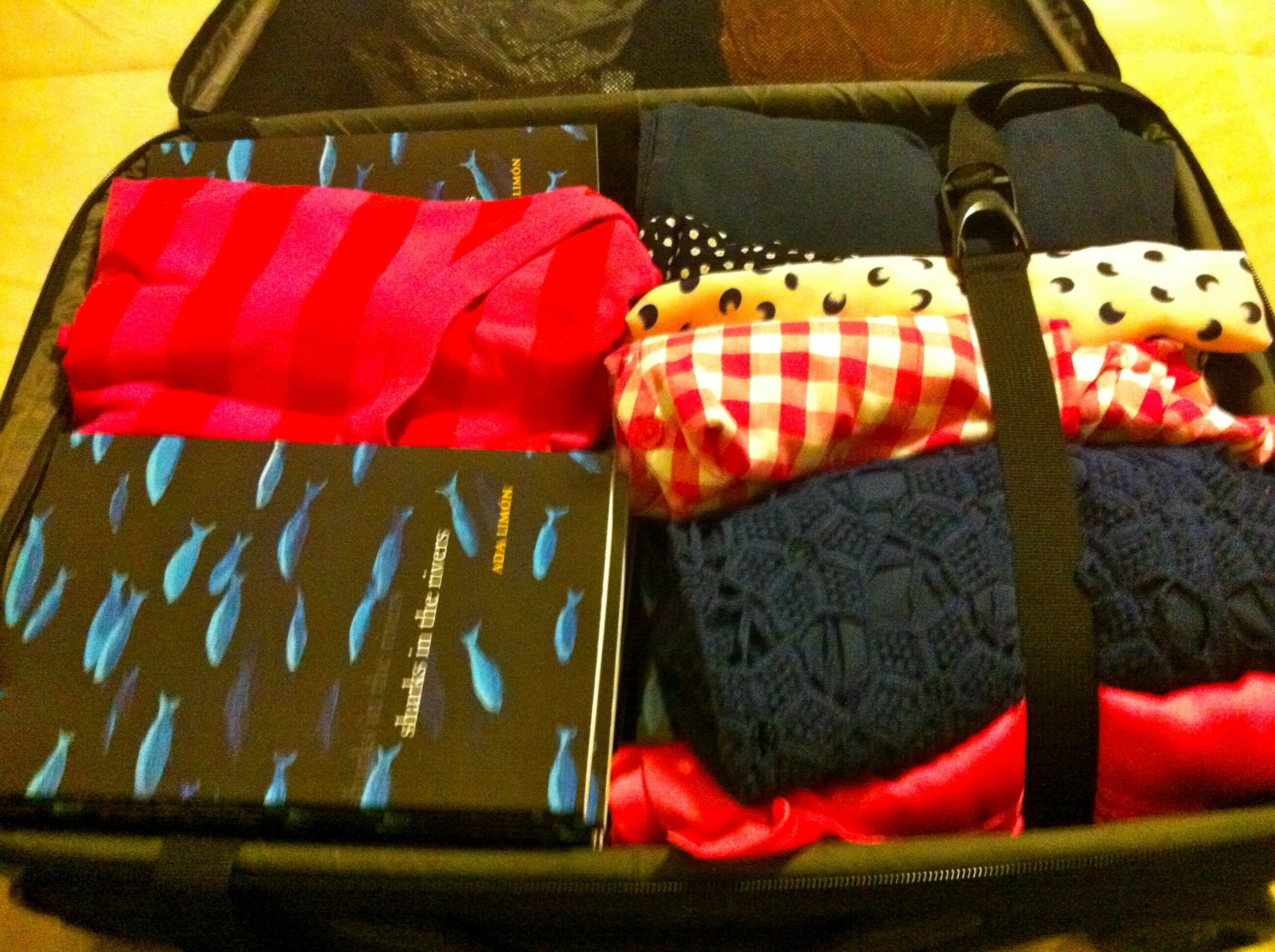
Packed and ready to go!

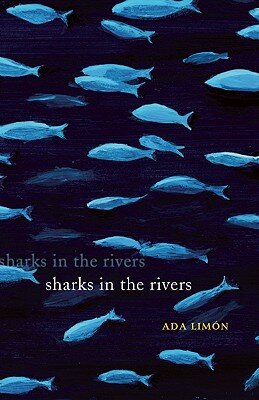
Suitcase packed with SHARKS IN THE RIVERS.

Read more…

vw84cover_largeQ: Voiceworks published your poem ‘Darlings’ in issue #84 PULP. How did you find the process?

I was so thrilled to see ‘Darling’ find its first home in ‘PULP’. That issue was published a little while before my 25th birthday, so I was almost but not quite too old to be sending poems to Voiceworks! As for the process, Voiceworks is very hands on, and I so admire the time and energy the editors put into their writers’ work, especially young and emerging writers. On the other hand, I’m inclined to feel that work should be accepted or not accept as is; that there’s something sort of tricky about accepting a piece of writing conditionally, with suggested edits, especially where such edits are extensive or significant. I suppose this depends on the writer and their experiences, and whether they’re looking for feedback, or to workshop what they’ve written. And honestly, who doesn’t love a reader—someone who will read your work closely and offer a detailed response of some sort? That Voiceworks also offers feedback to both successful and unsuccessful contributors is something else I really appreciate.

Snowline coverQ: You’ve just released your debut collection Snowline with Whitmore Press, congratulations! What did you do when you realised you would be 2012′s feature poet?

Thank you! Although I wasn’t 2012’s ‘feature poet’ as such — I was actually joint winner of the manuscript prize with Queensland poet B. R. Dionysius, whose collection is Bowra.In 2012 Whitmore Press also put out a chapbook by Luke Beesley, Balance, which is just stunning (and not only for its bright, lime jelly-green cover, which is so ace in itself!)—as well as a new full-length collection, Available Light by Graeme Kinross-Smith.

As for winning the prize, I was so thrilled just to make the shortlist, especially alongside so many amazing (and often-widely published) poets, whose work I admire. The email announcing the joint-winners came through quite late, from memory, but happily my partner lives not far from a bottle-o that seems to be open all hours, so we walked there to pick up a late celebratory drink. Most likely a bottle of cheap red wine.

Q: How does publishing your first collection feel? Does it change the way you see your creative work now?

It feels pretty surreal. Seeing and holding the chapbook was the first strange thing, and then knowing that people were reading the poems was even stranger; I’d only recently—in the last couple of years—started to try and publish my writing in a few journals here and there, so I was still very nervous about the whole thing. For a long time I didn’t know the opportunities that were out there, but what I was writing then wasn’t really publishable anyway.

I’m not sure if it changes the way I see my creative work, really, because I’m always quite self-critical. I also tend to want to put the things I’ve done behind me and move on to the next thing. But on the other hand, yes, of course it does—the prize and publication of Snowline were of course so validating, and also, for me, kind of terrifying.

I also feel very fortunate that Snowline has been reviewed a few times, less than a year on; I don’t know how much attention a chapbook usually gets, by comparison to a full-length collection, but I guess I thought I’d be lucky if it got just one little mention somewhere. As far as I know, though, it’s up to three reviews, and possibly a fourth coming up online, a bit later in the year. The first was in Metre Maids, with another in the September issue of the Australian Book Review, and a ‘review short’ over at Cordite.

Each one has been so positive and generous, which of course is validating again; and sort of surprising, too—part of me was so nervous somebody was going to say, ‘why’d they pick her?!’ So it’s been excitement filled with anxiety, but that’s probably not the worst thing. I tend to think self-doubt can often be quite useful.

Q: In reading Snowline there are continual motifs of returning, shifting from awake to asleep and landscapes that evoke nostalgia. What other concrete topics surface when writing? What are you naturally drawn to?

You know, I was only vaguely aware of these recurrences and patterns before, because to begin with I was writing the poems as individual pieces, without a collection in mind. I never thought I’d be putting together a manuscript—or not any time soon—but then when it came to choosing and ordering the poems for Snowline, I started to see the repetitions in another way, and started to think about them a bit more self-consciously. Maria Takolander, who launched the collection in May 2012, counted a few of them; I think human wrists appeared six times, for example.

So I suppose I’m naturally drawn to certain images, such as wrists and snow and glass and dreams, and also to memories made material and tangible. Having said that though, such memories aren’t necessarily personal autobiographical as such, especially not the later or more recent poems; I think it’s the image or the scene I’m drawn back to. Months after Snowline was published, it was a very warm spring; my neighbours’ magnolia trees were flowering like crazy, and I live close to Geelong’s Eastern Beach, but I was still writing poems about snow, about wintery Austrian landscapes. So perhaps that says something about nostalgia too, and the way that memories or remembered spaces resurface and repeat.

smallwhitmorelogo1Q: Clue us in to what the editorial process with Whitmore Press was like?

It was really wonderful. Anthony Lynch (my Whitmore Press publisher) is great—I really respect him as a poet, short story writer and critic, as well as an editor, and really valued working with him on Snowline.

Q: The poems ‘Rabbit’ and ‘Garlic’ are side by side, was this intentional?

Well, yes, but not in any meat and garnish kind of sense, if that’s what you’re suggesting! The ordering of the manuscript was decided over loose sheets of paper, spread out over my floor at home and shuffled around, again and again. ‘Rabbit’ and ‘Garlic’ weren’t intended as a pair as such, but I guess at the time I thought they would make good neighbours.

Q: Which poem were you most attached and why?

The answer to this question is always changing. Sometimes the poems I think don’t really ‘fit’ the collection, or the ones I’m not as fond of, are those people mention to me, or the pieces reviewers have cited (in a positive way). I must be very impressionable, because then I feel quite proud of—or at least okay about—that particular poem again.

I’m sure every writer feels his or her work change and develop, and it’s not such much that I think this or that piece is completely terrible, but more that some of them feel quite long ago, even if they’re not. It’s a sort of distancing effect, and maybe a feeling of ‘I don’t think I really write like that anymore’.

Q: Currently, what collection or poet/poem has you under its spell? What do you think we should be reading?

With poetry—and in fact, probably with other genres of writing too—I tend to be reading a few different things at once. New work by Australian writers, in various journals and magazines, is usually what sends me looking for full collections. Claire Potter’s Swallow was released a little while ago now, but it’s one I’m often returning to, and I’ve been excited to find new poems of hers here and there.

At the moment I’m also making my way through a borrowed copy of a Roy Fisher collection, and especially love a prose poem sequence called ‘Metamorphoses’, which is full of such spare yet beautiful images.

forrest300I was given Veronica Forrest-Thomson’s Collected Poems for Christmas, which very much has me under its spell—I fall for a new poem of hers each time I revisit the collection, and most recently my favourites are ‘For the Spider who Frequents Our Bath’ and ‘A Reaction to Rings’.

Another gift, a kind of hand-me-down present actually, is a book Roy Fisher’s poems. There’s
a poem in that collection I love, which is short enough to cite in full (I have a bit of a thing for
short poems, and this one is a particular favourite):

A WHITE CITY

My thoughts turn south
a white city
we will wake in one another’s arms.
I wake
and hear the steam pipe knock
like a metal heart
and find it has snowed.

And then there are a few single poems I seek out in collections and anthologies, to read again and again. Barrett Reid’s ‘The Absent Heart’ is a beautiful and devastating poem, and one I go searching for quite often. It’s in a book called Making Country, which I should probably read in full, but each time I open it, ‘The Absent Heart’ is the poem I seek out.

Q: What’s your favourite space to write in?

I’m pretty pragmatic, and I write when and where I can, which is usually at home. I don’t have a desk, but there’s a round dining table by some big windows that let in a lot of sun and overlook the street, and that space usually does the job nicely. I love to read in the bath, too, but for writing it’s pretty impractical.

Q: Can you let us in on any secret projects, or not so secret things you’re up to?

I’m a bit hopeless at keeping my own secrets – and luckily, with writing at least, I don’t have many. My biggest project at the moment is my doctoral thesis, which I’m undertaking at Deakin University. Part of that involves working on a creative artefact, which for my project is a work of fiction. I’m not very good at talking about it yet; maybe ask me for a better description (or synopsis, even) once it’s finished. The dissertation, however, is looking at elegy, melancholia and representations of trauma in magical realist literature.

Q: Will we be seeing Jo Langdon stamped onto collections in the future?

I certainly hope so, but who knows?


joJo Langdon is the author of a chapbook of poems titled Snowline (Whitmore Press, 2012). She is currently a PhD candidate at Deakin University, where she also teaches literary studies and professional and creative writing.

Sherry O’Keefe presents us with 4 vignettes which teach us how to launder our own imagery. This post reminds us constantly to look around ourselves, even the smallest of happenings are ones which can be spun into a poem or a story. Everything has a story. Everybody is their own storyteller.


Sugar On a Rope:

He told me potatoes were complicated. I know this is true because I wrote it on a scrap of paper and saved it in my back pocket. Some conversations later, I retrieved the scrap of paper from the lint trap in my dryer. Apparently I had laundered the words when I washed my jeans. The scrap of paper looked a bit like a former leaf, except I could see these words in faded ink: potatoes are complicated and some poems are born in badness. The trouble is I cannot remember the conversation that produced these quotes. I don’t remember anymore where these words came from.

I don’t always know what to keep and what to let go. I’m not the sort to let anything go. There are scraps of paper all over my house. For example, these are the words next to my kitchen sink: We don’t even need to talk about houses on the hill. As writers we deal with the hanging on and the not knowing when to let go.

When he talks to me, he uses panoramic strokes, coaxing me to see the big picture. And for a bit of time, I am right there with him, seeing the big picture. And in fact, I am enjoying the wide view his words offer . . . but then something happens as we keep talking. It is as though we go around a bend, chattering and laughing.

But the poetry-gene activates and the next thing I know I am on my knees, examining something minute, something telescopic.

Later, I will find more random words on scraps of paper:

sugar on a rope, failed harbor

What does it mean to want to be heard?

Little men lined up like starfish on the edge of a tidal pool

Did anything happen in 1882?

Some of these words will find homes in my poems. Some of these words will end as lint in my dryer. And (I am sorry to admit) I am not likely to remember the walk along the river, the wide blue sky, the way back to my car. I won’t remember taking these photos.

*

wheat2

When Someone Picks You Wheat:  

Comes a time we have known before, when we feel a bit out of sorts. Maybe the rain gutters on your house are threatening to rip off your eaves? Probably you are reluctant to climb the ladder and address the problem? Maybe you are feeling like Cali’s new black tire (what happened to the pink one?!) lost between the storm and the front door and no one has noticed you are missing? It may be I am not speaking about gutters and eaves, doors and tires. In an antique aqua blue vase next to my bed is a bouquet of wheat stalks. A few years ago someone read a short story I had written about wheat fields. And then a few went for a drive along the Hi-Line, thinking to take a photo of the crop and send me the photo. Others thought to stop and pick some stalks. Someone parted with a favorite vase. When I realize I am feeling invisible, or under-powered and not willing to climb ladders to save my eaves, the wheat stalks cheer me on. And when I say wheat stalks, I mean to say wheat pickers.


Trailing
First published by Free Fall Magazine in Calgary, Alberta.

He told me once that wheat was patient. If I needed
help with waiting, I should come to this farm field. Between

these stalks of sway and pause, and the horizoned Little Belts,
white pelicans flash and fish the river breaks. I trail the red rock

bank on Jeep, a buckskin mare. We climb dried-up gulches, thread
through bursts of orange paintbrush and bitterroot blooms

of baby-girl-pink. The sky is lonely when it is solid blue- this is why
it follows you. He called it the tag-along shadow. Two strips

of jerky, half of a water canteen. Three ravines to the backside
of Crow Pond. Jeep chomps along the edges of the field, I slip

the red blanket from her sweaty back. The west wind hushes shhhh,
think softly. Gray green yucca, white cottoned milk pods tickle

my bare legs. The more earth touches you when you are young,
the stronger you stand when you are ancient. I circle the rings of teepee

rock, spread the blanket down. Many palms have smoothed
this woven fabric. Jeep swishes her tail once. She’s not my horse-

this is not my dream. He told me once he knew where ghosts come
from. I take in his breath when he exhales. He’s been here forever.

*

signs

 Trespass 

One year my Christmas tree stayed in its stand until March before I hauled it outside to the curb. Twisted girl that I am, there are fluctuating moments in my life when I recall that year fondly. Maybe what I mean is painfully. That year I thought life had trespassed me. My brother talked me through those times. Told me when we learn everything we need, fits inside one Wal-Mart bag, then we’ve learned a liberating lesson. And now, some years later, we re-talked this in the cab of his 1960 Dodge.  Brother, daughter, dog and me. This is the brother who is good at restoring things. Once this pickup gets back to what it was originally meant to be, he will start on something else.

We were on our way to walking his latest dog along the river. This one had been rescued hours shy of being put down at the shelter. Eight months of constant care, she was a new and different dog. How far could I walk, he asked.  Five miles? Eight? He had things to show us. He stood along the river bank, pointing downstream. From here to there and back?

Yes. Sometimes the best path means losing sight of the river for awhile, a bit of trespass might be involved, he said.

Slow talk, long walk –we watched his dog chase gophers. This is the brother with some of the best story-telling ways. It’s all about pacing with a few teasing touches, he explained to my daughter. The longer we walked, the more she grinned – she knew where we were going. No matter which part of my family we spend time with when we visit Back Home, she’s discovered we end up way, way downstream looking down and across the water to where we (not she) grew up.

signsstartWe aren’t allowed access to the other side anymore. The power camp is gone, but if you squint just right you can see the water fountain and the apple orchard and the birch tree we used as second base. The first canyon where we ice-skated on the ponds, and the second hill where we flew kites. People from town drive out to this point, sit in their cars and take in the sight. Unless they get out of their cars and step across the barrier fencing they miss what the river is about. One hundred yards beyond the no-trespass sign is when you start to feel the power of water falling.


*


Don’t look directly at the shadow:

A day after Robb arrived for her annual visit, they piled into Dad’s pickup – Mom in the middle with my dad driving and Robb to my mother’s right. In the back, no doubt, was Roadey, my mother’s one-hundred-pound dog and a cooler with water and juices, carrot and celery sticks. Maybe even some of my mother’s cupcakes. Road trips without Mom’s food in a cooler haven’t happened yet.

Robb has made the annual Trip Back To Montana for at last fifty years. She is my mother’s best friend. By now, this threesome must have driven every back road and seen all there is to see Out Here. For those of you who have been reading this blog for a few months, you may have noticed how many times my dad’s landscape photos have shown up in here. He never tires of our vast landscape nor of  taking photos of the same plateaus, buttes, rock formations and faint wagon trails he visits on these drives.

shadowsThis trip, however, Robb asked my dad to stop in the middle of the gravel road. Take a picture of the praying hands she suggested in her back-easternly way. At first Dad couldn’t see what she was referring to-on account of the shadows along the ridge. Then he realized because of the shadows, the praying hands were possible to be seen.

At 12:51 A. M. this morning my BlackBerry buzzed on my nightstand. I rolled over in bed, knowing I had a new message from my dad (he doesn’t sleep at night). He had sent me the above photo and a quick note about what he’d learned. When we let shadows do what they do best, we see what they suggest.

What I like best about good poetry are the shadows between the words. Often the poem that vibrates inside me is the one which only suggests what might be revealed. I live for the gradual realization we experience when we let shadows work their tricks on us.


profile 2

Sherry O’Keefe, a descendant of Montana pioneers, grew up in a power camp on the Missouri River. Residing now near the Yellowstone River, she is a poetry editor for IthacaLit and an assistant editor for Fifth Wednesday Journal. Her work can be found in Camas: The Nature of the West, Terrain.org, Art & Document  and many other journals. Her most recent collection of poetry, Cracking Geodes Open, was released by Aldrich Press in 2012. Visit her: http://toomuchaugust.wordpress.com.

VERANDAH 3 COPIES


Verandah is a literary and visual art journal published in Melbourne, Australia. Founded as a student-run publication, the first issue launched in 1986. Originally situated beneath the shade of the vast verandah’s surrounding Victoria College, a place in which the journal takes its namesake. The publication puts emphasis on new and emerging writers and fosters creative talent and skill. It honours the work of Deakin University students, but also calls for submissions from across international writers and poets. The journal also gives out prizes according to category. The Matthew Rocca Poetry Prize was named after a dedicated student of Deakin, who unfortunately passed away during a year of study, his parent’s have fossilised his love of poetry within this prize.

2013 will mark its 28th year in print and editors are currently seeking submissions of short literature and poetry for publication later this year. Your closing date is June 1. We are honoured to extend this invitation to Metre Maid readers and look forward to reading your submissions. Submission fees are fed back into the publication at no profit to the University or volunteer staff.

For guidelines, check out www.deakin.edu.au/verandah

This years editors are Hayley Ryan-Elliot, Jonathan Lawrence, Kyah Horrocks, Lauren Hawkins and Leizl Bermejo


StarMarriage


Last year I had the words ‘you that sang to me once sing to me now’ tattooed on my right inside forearm. This was not a mid-life crisis act but was overwhelmingly to do with poetry.
The quotation is the first line of a poem by W. S. Merwin ‘Song of the Nomad Flute’ is a poem which appears in The Shadowsof Sirius,[i] a collection which was published in Merwin’s 80th year. I’ve read and re-read this collection, finding new lines and images that sing to me on each reading. When I embarked on my year of learning poetry by heart, ‘Song of the Nomad Flute’ was the first unrhymed poem I learnt. I followed it with another from the same collection – ‘Good Night’, which has some intricate repetition in it and appears to be a farewell to a beloved dog (although I wouldn’t mind having it read at my funeral!).

But my admiration of the individual poems in this book did not impel to me have that line forever inked into my skin. It was the more the collection as a whole and the age at which Merwin published it. Over the last few years, this collection, more than any other, has come to exemplify for me the kind of unapologetic poetry a poet should write and keep writing.

I think there are times in every writing career when a writer reaches a pause. It isn’t exactly writer’s block. Nor is it entirely a period of evaluation. Perhaps you’ve balanced a day job and family life with the private job of writing for a number of years. Perhaps you’ve given writing precedence in your life and you look around you to find that your friends have other lives, plan holidays and do more than window shop. You wonder why you’re writing when you could do so many different things.

When I paused, it was more like fatigue  –   but fatigue with the anxiety that surrounds writing. I was tired of trying to make time  every day to write. I was tired of wondering whether what I was writing was good enough. I wondered whether or not I was pushing my own boundaries. I knew I wasn’t submitting work regularly. I’d let elements of my writing life slip while I attempted to finish other writing projects that clamoured for my attention. At the end, I was simply exhausted by my own mouse-on-a-wheel anxieties.

It didn’t help that my part-time day job was online-teaching, an isolating occupation. Nor did the state of the publishing and related industries help. It was difficult to maintain faith in my profession when I heard almost weekly of independent bookshops closing down, publishers retrenching editors and abandoning imprints and genres. Who would be left publishing poetry when the dust had settled?

the Shadow of SiriusThen I re-opened Merwin’s collection and read his limpid, spare yet mysterious and intimate poems. I was struck by their fearlessness. Some of the lyric poems in The Shadow of Sirius talk in the ‘unadorned voice of a close companion who speaks softly and urgently, as it were, into one’s very ear.’ [ii] It seemed to me that Merwin, as an older poet, was relaxing into his craft. I was very aware that his apparent simplicity – is the result of a lifetime’s rigorous editing and rewriting. I couldn’t speculate how – or indeed whether – Merwin has arrived at a place where all experiences can be accepted, but I could work on my own fear. The first step for me was being reminded that poetry keeps singing to you if you remain open. In my case it was already inked into my skin. I’m not suggesting you do that! But I have compiled a small do-it-yourself list for anyone who also feels that they are paused in their writing career.


  1. Don’t panic. You might simply need a holiday. Everyone else takes a holiday, so why can’t a writer? Declare a holiday for your writing self. Make sure that you note the start and end of your writing holiday on a calendar or in a diary. (You may, of course, write during this period, but don’t feel guilty if you don’t.)
  2. Make some simple goals – decide, for example, to write one poem a month, or submit five poems to competitions. Write these down and tick them off when you complete them.
  3. Attend poetry readings – hearing other people read their work, reading your own work  and just hanging out with other poets can be enriching and make you remember you are part of a poetic continuum.
  4. Set yourself some writing tasks – call these ‘Doing the Scales’ or any other name that implies practice writing. Schedule these into your day or your week.
  5. Finally, write something quite different. Write a picture book. Write a script. Embark on an interlinked narrative about smart young things living in five different space stations, bookended with sharp haiku that all have to have the word star in them.


May that which sang to you once, sing to you now.


[i] Merwin, W. S., The Shadow of Sirius, Copper Canyon Press, 2008.

[ii] http://thecresset.org/2012/Trinity/Weinert_T2012.html 


IMG_7054


Catherine Bateson is an Australian poet and writer for children and young adults. Her last poetry collection , Marriage for Beginners, was published by John Leonard Press. She partially overcame her writing anxieties by joining the Tuesday Poem Blog group and posting a poem on her own blog each Tuesday. In June this year she heads to Paris for three months, courtesy of an Australia Council Grant.


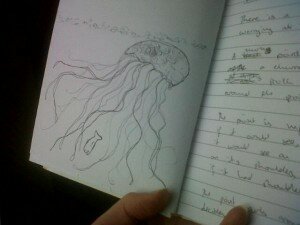
I also drew whale-eating-jellyfish to keep myself sane in the dark days.

I also drew whale-eating-jellyfish to keep myself sane in the dark days.

It’s quite simple: Today is May 4th and I am on poem 28.

Assuming I write two more poems in the next few days, I will have done NaPoWriMo five times. By “done” I mean I’ll have written 30 poems, in quick succession, with no regard for their quality, around April-kind-of-time in five separate years. A NaPuritan might say this doesn’t count. They might decree I have to write exactly one poem, every day, thirty days running starting April 1st, or it isn’t NaPo. Someone a little less hardcore might say that I should, at least, wind up by April 30th. And if that floats their boat then I wish them a good voyage.

But I don’t think it matters. It would matter if, come May 1st, all the grist dropped out of my mill and I a stopped writing. It would matter if, among the wasted days of poetic incontinence, I failed to indulge in an occasional verse orgy. But I’m easygoing. And poetically libidinous. And I don’t mind dragging the affair out.

Embarrassment is part and parcel of the NaPoWriMo business. This year I indulged in love poetry and angst like I never did this as a teen. Obviously I was making up for lost time. For instance:

27/4

I don’t just want you to be here
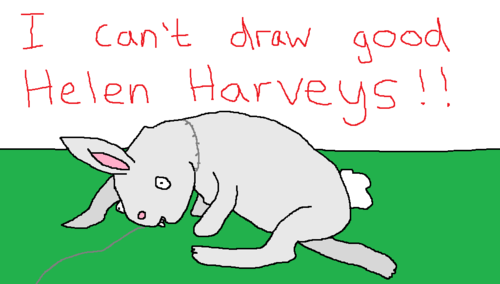
Art by Chris Giles of My Beautiful Paintings

I want to make you be here, tie you
to a string round my wrist and drag you,
not like a puppy,
but like an angry rabbit.

20/4

If you always head east, head west,
just drive. Turn up the hi-fi
and try not to think.

You’re thinking.
Don’t think, just keep breathing and blinking,
you’re thinking, you’re thinking, don’t think.

No, don’t blush for me, I’ll own my own inadequacies.

But that’s not all! No, this year I wrote about twitterxkcddinosaur comicsGotye covers and cat videos. I wrote lovingly of the arcane Gloucestershire tradition of cheese rolling, a sport so dangerous it was banned (but has that stopped the free cheese rolling spirits of Gloucester? NEVER).

These are natives of Gloucester chasing a cheese that is rolling down a hill.

These are natives of Gloucester chasing a cheese that is rolling down a hill.

This year I sat on the carpet with my mother at 1:38am watching a storm and discussing matricide, then wrote a poem about sitting on the carpet with my mother at 1:38am watching a storm and discussing matricide. This is how it starts:

1:38am

I sat on the bedroom carpet
with my mother
discussing matricide.

It continues like this -

A mirth of matricides? she said,
a perpetuation of matricides
would that work?

A legacy of matricides, I remarked.

And concludes,

We were waiting for the lightning
to strike the church opposite,
for the cat to squeal and run for the towel basket,
for grandma to pass on.

So now you know.

(Actually I quite like that one. I guess I’m just lucky enough to have a mum who is insane.)

In all honesty I’ve written reams of total gibberish this month. But I’ve never been one to cling desperately to a dead poem in the hope that a wizard will come along with a spell to make it live. I don’t mind writing a bit of dross to get to the good stuff. Actually most of my best poems I’ve typed hurriedly in a moment of procrastination or in a lunch break, thinking they were awful. It’s only later, sometimes months later, I look back and realise they’ve got something worth redeeming. The poems I labour over always come out laboured.

I expect NaPoWriMo isn’t for everyone. I expect I am exactly the sort of person NaPoWriMo is for. The type of person who gets bored easily; who constantly wants to start the next project, and not worry about perfecting the last one; a goal-orientated workaholic; and the type of writer who only has two settings when it comes to editing, tweak and overhaul.
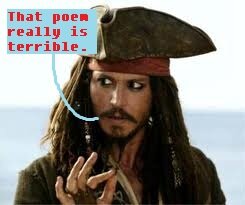
I will leave you with an inspired piece from day 3:

Pirates! Three of them
on the fo’castle
doing a jig:
knees up knees up
clink hi ho!
Not interested in a
whale like me.
If your life is burning, well then poetry is just the ash.
–Leonard Cohen

Words.  God, I love them.  Unpredictable.  Knotted.  Liquid.  Percussive. Baked and flat.  Round.  Grainy.  Leached and slim.

And the silences.  I love them more than words.   Empty.  Heavy.  Thorned.  Sometimes taut.  Sometimes fat.  Glassy and stilled.  Ridged.  Slicked.  Stuffed and flexed.

I wrote my first poem when I was 4.  I would like to say it was mensa material, but frankly, it was terrible.  What I still marvel at is that I was always drawn to this form of expression.  I didn’t know what a poem meant but I loved it purely.  The value of words, their weight, their counterweight.  The vowels, the bones, the muscles.  Weeding through the fat.  Now, I recalibrate daily to stay as much as possible in that original love.  To resist wanting to control the words.  It’s a fight to not domesticate the poem.

Process.  Every time.  Walking into each poem, the moment can turn out to be as small as a second and as big as a bull ring.  For me, it always feels like a blood sport.  Primal but epic.  Personal yet external.  Once I exhaust myself, I can slide into surrender.  Finally, I can give in to the release that builds when you let the poem rise up.  Sometimes it hunts me.  Sometimes it wades.  Sometimes it’s a whisper that I have to grab the tail of and wrestle down.  I like the surprise and letting the alchemy take over.

And then of course, there is the poem that resists me.  For months, I keep catching glimpses.  I know it’s there.  It’ll make eyes at me and poof, it’s gone.  Occasionally, it will come back.  And when it does, I have to be ready for it.  I have to be a snake charmer, very still and seductive, to trap it while it’s doing its dizzy dance.

After that, comes surgery.  Not always but often.  The pruning but not over pruning.  I mustn’t carve out its heartbeat.  That has to stay wild, untamed.  The poem must maintain its ineffable urge that brought it from a thought spark to paper.

And finally, comes the selfishness.  Poetry is my high.  I’m an addict.  Greedy for words.  And even more greedy to be unlocked.  To feel like I’m sitting in the lap of life. In sync.  With secrets dropping from the sky.   I want to burn up life.   And poetry is just the ash.

You see, I want a lot.
Maybe I want it all:
the dakrness of each endless fall,
the shimmering light if each ascent.

–Rainer Maria Rilke


Elena Evangelo.

Elena Evangelo was born and raised in New York City’s Chelsea district to Greek immigrants.

She graduated from Vassar College with her B.A. in English and French. Afterwards, she received her M.F.A. from the USC, School of Cinematic Arts, graduating Phi Kappa Phi. There, she was also awarded The Jeffrey Jones Screenwriting Scholarship and The Ray Stark/ Ted Turner MGM Award. Elena also went on to Paris to study French Theater through NYU.

Elena has appeared in the films G.I. Joe Rise of Cobra and Purpose and is slated to star in the epic East of Byzantium. Her television work includes roles on Justified, Revenge, Body Of Proof, CSI Miami, 90210, Monk…

She is also a published poet and continues to produce and direct films.