I couldn’t read until I was 9 years old, I stared at the words and imagined all sorts of things, longingly filling in the blanks for myself. I pretended to read out loud, I loved the sound of words and how it felt when I was telling a story, but the idea of words was something I only ever enjoyed in private, in places where there were no consequences. School was a treacherous place, and words were hostile, they humiliated me, they played cruel tricks. At the age of nine, after weeks of unsuccessfully tackling the classic b and d problem (confusing one for the other that is), in a fit of intense frustration, I marched up to the white board in front of my entire class and wrote ‘Amy is dumb’, or that’s what I meant to write, what I had in fact written was ‘Amy is bum’. There was of course much laughter, the creation of a new nick name ‘Nunn bum’ and an ongoing practical joke involving a peanut butter sandwich left on my chair. Okay so not my finest moment, but one that began a strange and significant chain of events. This was the moment I quietly promised myself to get even one day, to use the enemy’s weapons against them, wreak havoc, to show them all.

At the age of 12 I moved with my family to Australia, where unfortunately dyslexia is barely recognised within the education system. I was put into a ‘special needs’ class with children who had severe mental disabilities, and spent my days feeling utterly lost, isolated and deeply ashamed. After a few years of my mother pleading with teachers and doing everything in her power to bend a very rigid system, it eventually became clear that my best option was to live with my father back in London for a trial period, where I could attend a dyslexic school.

Being accepted into this dyslexic school felt kind of like being accepted into Hogwarts, except that it was the size of a postage stamp with a student population of about 80, and looked like the Berlin wall, post 1989. No one could speak to snakes or fly, but the students did have special abilities, things they were exceptionally good at that might have gone completely unnoticed somewhere else. One student who had trouble spelling his name at 14, could play Mozart by ear and have a basic understanding of almost any instrument handed to him within the space of a music lesson. Another student, who is now an actor, learnt all his lines in our school play by listening to them recorded on a Dictaphone by our drama teacher. Our headmaster lead yoga classes before exams and quoted the red hot chilli peppers in assembly, my English teacher had numerical dyslexia and barely knew her 5x’s tables. I felt as though i’d discovered an island of lost toys, we were part of a clan, and it didn’t matter that we’d been rejected in the past, because now we were wanted. There was nothing wrong with us, and maybe there never had been.

The occasional jeering from other schools on the way home (not helped by the words ‘dyslexics can achieve’ sewn onto our jumpers in lime green) seemed like a fair toll for this sanctuary. It was there that I learnt not to implode every time I made a mistake, to laugh with myself and not at myself, I found friends who’d all experienced some version of my humiliation at their previous schools (some much, much worse!) and I had teachers who recognised me as an individual, not a bad grade. Of course this institution, like all institutions was not without its problems, but I don’t feel I’m exaggerating when I say that in many ways, it saved me. Perhaps most significantly,  It was also here that I began to write. I didn’t know it was poetry at first, I didn’t really care what it was, only that for the first time it wasn’t about being right, it was about being free. My English teacher leant me books of poetry, Stevie Smith and Dylan Thomas were among the first, then Carl Sandberg and Gertrude Stein, Walt Whitman and Sylvia Plath. The words petrified me but not in the same way the had before, they were alive in my stomach, they meant business. I read more and more, suddenly I was hungry, scribbling in note books every chance I got, I began discovering language in a way I had never thought possible for myself. This was when it first occurred to me, something I’d always considered a hindrance, could in fact be a help.

Happy accidents are all around us, and are bountiful if not fundamental when it comes to the arts. Man Ray (once described as ‘the great poet of the dark room’) and Lee Miller discovered the technique of solarisation when a rat ran across the dark room floor and Miller flicked the light on in a panic. There is a deep intellectual fear of wrongness, of being humiliated by your own limitations or your inability to dazzle the world. We freeze, become hostile and rigid. This is the death of creativity, and of our vulnerability, without which genuine creativity would be impossible. Mistakes can also lead us to something infinitely more wonderful, they can lead us to our gifts, remind us why it is we love what we do.

I can’t help but wonder, had I not been told I was wrong so often, would I have been compelled to discover my own language, or been interested in poetry at all? Who can say, but if I’ve learnt something from my experience as a dyslexic poet it’s this, sometimes we should let them see us naked, let our poetry be bad in bed, expose the syntax cellulite and pock marked prose, put it all under the most unflattering, stark lighting available and just let it be wrong. Sometimes being wrong is so damn right.


DSC_0339


Amy May Nunn is a Melbourne based poet, she has been published in various literary journals and is currently working on her first collection.

If your childhood was anything like mine, you spent an awful lot of time playing Silly Sentences: writing a few lines, then folding the paper over neatly and passing it to your friend, who would continue the story with what were, for eleven year-olds, hilarious results. We played it at nearly every sleepover and most school sporting events, having faked sore ankles to get out of anything as unseemly as exercise. I probably still have all those accordioned bits of creation somewhere at home.

Art by Chris Giles of My Beautiful Paintings.

Years later, I’ve become similarly addicted to Silly Sentences’ more noble counterpart, Exquisite Corpse. Wikipedia tells us that Exquisite Corpse is a Surrealist technique which grew out of an old parlour game known as Consequences, which itself sounds more or less like Silly Sentences only with a slightly more dignified name. In an Exquisite Corpse, each poet writes a line, with only the line immediately preceding theirs as a clue to where the poem is going. The number of poets can vary, as can the number of circuits the confused train of logic makes through the city of conception. For someone like me, terminally frustrated by a sense of aggressive perfectionism, it’s a wonderful way to cut loose and just let the words flow. It’s kind of like a trust fall for poetry–there’s always someone else there to catch you.

I owe my discovery of the Exquisite Corpse form to Roddiek Cuyno: computer science student, fellow poet and regular denizen of the art community deviantART. Actually, I’ve just realised that this post, quite by coincidence, commemorates the first anniversary of his efforts to bash our brains together in the name of poetry. According to Roddiek, “There wasn’t really anything special that started it. I was simply procrastinating on writing this short story one day and felt like playing the game to further my goal of not getting anything done. I then realized I had all these great writer friends who were probably also procrastinating that I could collaborate with…The rest is history, and I never did finish that short story. ” Read more…

Myth: the essence of a poem is expressing emotion.

The Word Vomit Technique. Illustration by Chris Giles of My Beautiful Paintings.

Before I get all grr on “emotional poetry,” I want to say this: I’m all about poeming in the diary, discussing heartbreak and daily doings, but that doesn’t make a poem great.  And great poems can express big feelings.  In fact, any good piece of writing should evoke emotion in the reader.  It’s what connects the reader to the work.  But just as in novels and essays and all that prosey stuff, a good poem has a story first.

A story has a beginning, a middle, and an end.  A story uses sensory detail, characterization, setting, and narrative to work its magic on the reader.  And why should a poem be any different?  A story is all the good stuff that brings us around to the feelings.  It has to come first.  It’s like Step 1.  And much like Ikea furniture, it’s a good idea in poetry to perform step 1 before trying to install step 2.

So my theory is this: A good poem isn’t about emotions, it makes the reader emote.  It evokes emotion in the reader by using emotive imagery.  And to achieve this, you’ve gotta start at ground level or else your whole poem is going to fall apart just like a poorly furnished college apartment.

Now, emotional poetry is definitely a thing and a lot of writers love it and it’s where a lot of us start as poets.  There’s a reason I recommend Sylvia Plath to many beginning poets trudging their way through the perils of high school.  I think she is the original emo kid — she’s got her heart on her sleeve and she’s not afraid to use it.  But the thing that Sylvia has that a lot of journal poetry doesn’t is the sense of story that I already mentioned, the imagery and sensory detail.  Plus, you know, that haunting voice.  Here’s an example:

“April 18″

the slime of all my yesterdays
rots in the hollow of my skull

and if my stomach would contract
because of some explicable phenomenon
such as pregnancy or constipation

I would not remember you

or that because of sleep
infrequent as a moon of greencheese
that because of food
nourishing as violet leaves
that because of these

and in a few fatal yards of grass
in a few spaces of sky and treetops

a future was lost yesterday
as easily and irretrievably
as a tennis ball at twilight

–Sylvia Plath

SO.  Love or hate Sylvia Plath, we can all agree on a two things:
1. She tells a story with her poem.  It has a beginning, a middle, and an end.
2. She makes us feel things.

Sylvia Plath leads an emo band. Illustration by Chris Giles of My Beautiful Paintings.

Imagine if the poem were simply a list of feelings, though.  Would that be interesting?  I don’t think so.  Anyone can list feelings and use a thesaurus to come up with a few extra S.A.T. words for “grumpy” and “tears” and throw in some linebreaks and call it a poem.  What I want from a poem when I’m reading is a reason to feel for the narrator, a sense of what the narrator feels and why.  And, duh, I want that story.

So, Sylvia Plath nails it with that  #2. She makes us feel things.  And she uses all those tricks that I believe make a poem work.  I mean, wow, that first couplet?  It’s dark.  It’s creepy.  And it’s so, so sad.  Even better, in this and in so much of Plath’s poetry, there is space for the reader to go in, suck in the words, swirl them around in his mouth, and taste what he needs to taste.  He may or may not like the poem, but he hasn’t just had to consume word vomit.  Which, really, is what happens if you just let your feelings dance around unhinged while writing.

I’m sorry, folks.  But your word vomit — or soul vomit, as I’ve come to think of some of the more, er, emotional poetry that, yes, even I wrote back in the day — belongs in a first draft or in a journal.

And really, I have to wonder, where does this myth that poetry = emotion come from? Is it our schools, where overworked and underpaid teachers are given a single week in which to teach poetry by the Powers That Be?  Is it the fact that contemporary works are physically inaccessible to young people and are, indeed, less read than, say, Shakespeare’s soppy (if lovely) sonnets?  Regardless, I’d say that emotions in poetry is a good thing, and I’d encourage any poet endeavoring to make his readers feel something to use his words to do just that. Make the reader feel it.


© Claire Sambrook.


It all started with a box of teeth-whitening strips.

In graduate school, my friends and I coordinated a small, online writing group where we would take turns posting and responding to a prompt of the week. On the particular week in question, we were challenged to write a poem using only the words found on product packaging.

Initially skeptical, I reached for the nearest product in my apartment, copied down all of the words from the box and began rearranging. Within half an hour, I had unwittingly written my first found poem. Not only that, I’d actually had fun doing so.

Later, whenever I would find myself struggling to write something original, I would turn to found poetry as an exercise, a way to unclog the creative pipes. Eventually, I began practicing it nearly exclusively, crafting poems from speeches, menus, Twitter streams and more.

In 2011, my own experiences writing and publishing sparked the idea for the Found Poetry Review, a venue designed to showcase how individuals are finding poetry in existing and everyday sources, and to encourage people to write their own found poems.

So, What Is Found Poetry Exactly?  

Most definitions of found poetry – sometimes called erasure poetry or blackout poetry –  employ a collage metaphor to describe how poets cut out words and phrases from texts and stick them together to create something new.

Invoking safety scissors and glue stick projects gets the basic mechanics across, but  doesn’t do a great job of conveying found poetry’s intentionality and art. My favorite description comes from Annie Dillard’s introduction to her collection of found poems, MORNINGS LIKE THESE:

Those happy poets who write found poetry go pawing through popular culture like sculptors on trash heaps. They hold and wave aloft usable artifacts and fragments: jingles and ad copy, menus and broadcasts — all objet trouvés, the literary equivalents of Warhol’s Campbell’s soup cans and Duchamp’s bicycle. By entering a found text as a poem, the poet doubles its context. The original meaning remains intact, but now it swings between two poles. The poet adds, or at any rate, increases the elements of delight. This is an urban, youthful, ironic, cruising kind of poetry.

Not only does Dillard’s definition provide a clearer picture of both found poetry and the people who write it, but it also gives us a better understanding of its detractors. Editors who will inevitably cry “plagiarism!” and “unoriginal!” are but a few branches down the family tree from the conservative art critics who turned up their noses at readymade and pop art in the mid-twentieth century.


Finding a Good Poem
© Jake Bouma.


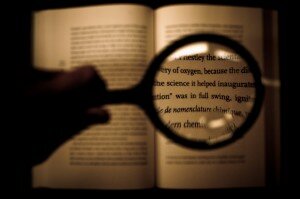
Imposing parameters or restrictions on experimental writing like found poetry is usually considered bad form; however, working on the The Found Poetry Review has forced me to make decisions about what I consider a quality poem.

I’d put the types of submissions we receive into three broad buckets:

1.     Reportage: These pieces excerpt sequential lines from a source text, with the primary intervention being the addition of line breaks or spaces. Photographs of juxtaposed signs or graffiti also fall into this group.

2.     Distillation: Poems in this category take words and phrases from a source text, rearranging them into a final piece that retains the text’s general message but is arranged in a new way.

3.     Reinvention: Submissions falling into this group take words and phrases from a text, but arrange them in ways so that the poem’s meaning has little or nothing to do with that of the source material.

Most of the poems we accept at The Found Poetry Review come from the second and third groups. When evaluating traditional poetry, editors look for originality in words and sentiment; in found poetry, I look for originality in arrangement. What can you add to the source material? What new story can you find within the original?

Poems from the first group are problematic for me, both as an editor and a writer of found poetry. Singling out a pithy paragraph in Lolita, pressing the return key a few times and calling it a found poem doesn’t do much for me on the editorial front – it’s not surprising or inventive. More significantly, as someone who writes found poetry and tries to build a case for it’s value and art, I see these “reportage” poems as walking too fine a line between plagiarism and ingenuity.


Where to Begin: Crafting Your First Found Poem

Because found poetry is experimental and so individual, I encourage curious writers to jump in first and read examples from the field later. You need to play around before you can get serious.

Since you’re presumably reading this post on the Internet, Wave Books’ erasure tool is a great place to start digging. There, you can choose one of 20 source materials to work with, then use an interactive tool to click and erase words from the text until you arrive at a final poem.

When working electronically from a web-based source (Project Gutenberg, with it’s wealth of public domain source texts, is a good place to begin), you can also consider pulling up two windows side by side – one with your source text and the other with a blank Word document. Skim through the text quickly, copying over into the document interesting words and phrases. Condense and reorder those snippets to create your found poem.

Offline, approach any text – from your morning newspaper to your favorite book to your pile of junk mail – with a pen in hand. As you read, underline or circle words and phrases, then try to work them into a poem. You also have permission to get out those scissors I referenced at the beginning of this post – cut up texts into strips, mix them up and then physically rearrange them on a board or table.

Enlarge Your Practice by Learning from Others
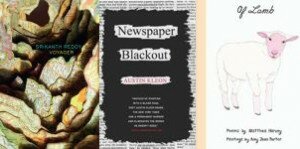
After you’ve taken some time to play around and understand your natural instincts when it comes to writing found poetry, take the time to read what others are doing in the field. Seeing how other writers approach the same art form – and perhaps even the same texts – will help you enlarge your practice.


Below is a short list of some published works of found poetry to buy online or request from your local library:

Online journals such as The Found Poetry Review and Verbatim Poetry also feature plenty of examples from other poets that may spark an idea for your own work.

Finally, be sure to let others learn from you. Post your found poetry on your blog or website, introduce it to your writing group and submit your works to online journals for publication. If you’re a teacher, try a found poetry exercise with your class.

If you’ve written found poetry or have favorite pieces from others to share, be sure to post the text or a link in the comments section below!

Jenni B. Baker.

Jenni B. Baker is the founder and editor-in-chief of the Found Poetry Review. Her poetry has appeared in over a dozen publications, including InDigest Magazine, The Newport Review, qarrtisiluni and BluePrintReview. She is currently working on a manuscript of found poetry derived from David Foster Wallace’s Infinite Jest, titled Fest.


So back when we started this blog, we were filling out our bios, and under influences I listed Chris Carter — creator of one of my favorite TV shows, The X Files.  Sarah messaged me and said “oh, wait, I thought we were just filling in our influences as poets.” And I was like “Um, yeah.  Chris Carter is totally one of my poetic influences.”  Sarah and I have long had a relationship in which almost nothing we say to each other is all that weird — at least to us — so we continued with putting together the blog and haven’t spoken of it since.

Illustration by Chris Giles.

Until today.  I want to talk about my X Files poetry.

First, I want to get this out of the way: TV is a brain-rotting time-suck of the modern world and no good things can possibly come from a 90′s show about aliens and poltergeists and sewer monsters.   Look, y’all — a story is a story, writing is writing, and inspiration is inspiration.  I really don’t care what form it takes.  There’s good TV and bad TV, good books and bad books.  I have no shame in finding inspiration in the stories written for television and film.  Among other influences I count Buffy the Vampire Slayer, Scrubs, John Hughes’ body of work and this teen movie from when I was in high school called Can’t Hardly Wait.

Art by Chris Giles.

I think what makes the shows I love so brilliant and so inspiring is how, whether comedic or tragic, realistic or speculative, they get the nature of humanity.  The dialogue in Buffy is snappy, Scrubs knows how to take a big, epic theme and smoosh it into a 30-minute episode while following multiple plot threads AND J.D.’s dream sequences, and for as much as I’ve rolled my eyes at some of those oh-so-Chris-Carter monologues delivered at the beginnings of of all of the Very Serious Episodes of The X-Files, damn they’re poetic.  And I think that’s when I got it — that there is beauty in science, science fiction, and back around again to science.  That the way we connect to the weird and wonderful and wondrous is something worth writing about.  And I wanted to write about it myself.  I needed to make poems about the Sasquatch and el chupacabra.  So I did.  I wrote those poems.  I wrote a novel about the Jersey Devil.  And I researched Christopher Columbus and the Bermuda Triangle and wrote that poem, too.

Art by Chris Giles.

Recently I’ve started collecting my paranormal pieces for a chapbook I’m working on.  Ghost hunters, UFOlogists, lake monsters, teenage necromancers and urban legends.  I think I learned how to write about these things with tact from Chris Carter.  It’s a place where fantasy and reality meet and while I consider myself a skeptic, well, like Mulder and Scully, I want to believe.  I want to tell the stories about maybe and could be.  And poems are story distilled down to the hardest bits — which is one thing I love about writing poetry.  X Files poetry, then, is these what ifs in their hardest bits, with me doing my best to make it lyrical and beautiful.  I wish I could say it was hard — but I love it too much.  A challenge, though.  I’ll say it’s that.

I have maybe 15 or so pieces for my would-be chapbook.  I have no idea if it will ever see the light of day.  But on my hard drive, it’s fun to look at, to read aloud, to speculate upon.  Below is an excerpt, my poem “The Leeds Baby.” Meanwhile, readers, do you have any unexpected influences for your work?  Please feel free to list them below! And, you know, ask Chris Giles to illustrate them on his tumblr.

“The Leeds Baby”

I couldn’t keep the child – the nurse said as much
as the doctor pulled its body from inside me.

Of course I’d whispered curses on these lips.  But this is quotidian
in the cold North East, standing mere moments from witchery.

The child, though – shouldn’t he be innocent?  Even when Hell
has molded bones into wings,  stretched the eyes red,
hunched the body’s back into a desperate “U.”

I loathed the thing, and yet, as Mother, I sent the nurse away,
clutched my baby, nursed him. Here is humanity, I thought.

Nights, I watch him sneak out his window at the side of the house.
Look, I think, God’s little gift is off to play in the woods.

He believes me ignorant. But mothers have a sixth sense
when it comes to wayward sons.

– E. Kristin Anderson, 2012.