Let’s start with the truth. It gets important later. It seems that all poets must state their position in regards to the place of truth in poetry at some point. In his Poetic Principle, Edgar Allan Poe claims that poetry ‘has no concern whatever either with Duty or with Truth’. However in discussing truth in poetry Poe is railing against what he calls ‘the heresy of The Didactic’, the belief, popular at the time, that every poem should contain a moral. Nor is this merely a concern of nineteenth-century Bostonians. In schools and universities students are too often taught to be interpreters of poetry rather than practitioners. They put the poet on trial and his poems are evidence­—his heart to be weighed against a feather in the hall of Ma’at. Poetry becomes a mode in which experience is digested for its moral content and then dramatised and displayed for the reader.

This mode of poetic truth seems repugnant and is something I endeavor to avoid in my own poetry, but isn’t truth intrinsic to poetry? At least in the Universalist sense that the way in which we, as writers, see and interact with the world allows us to create a fictive truth to resonate with readers. Readers bring with them their own personal projections that lead to varying interpretations of the poem and yet the emotional truth the poet has created is such that the reader knows that epic, romantic love is real, thoughts are like foxes and that the nightingale probably is immortal. It is this type of truth that I aim for, universal and emotional rather than moralistic or biographical. The truth is that every time I’ve written autobiographical or ‘issue’ poems they have become so heavily symbolised that the sad, broken things have to be put somewhere where no one will have to see them or hear their awful squalling.

Rhyme has been a conundrum since Milton derided the ‘troublesome and modern bondage of rhyming’ as ‘the jingling sound of like endings’. But rhyme can be far more than simple couplets. Rhymes may be so far apart, you cannot hear them, but they can hear each other, like whales calling each other across an ocean. The freedom to non-rhyme must include the freedom to rhyme. But the choice of rhymed or non-rhymed must be consistent within the poem. A partially rhymed poem is a sloppy and sad thing, a child sent to school with a dirty face and mismatched shoes. Rhyme in the modern era is derided as doggerel, seen as the domain of children’s poetry and light verse. At best it is satiric, but poets such as Elizabeth Bishop have shown that traditional rhymed verse forms can be applied to modern subjects with wonderful effect. This is something I like to attempt in my poetry: the juxtaposition of modern subjects or settings with the grace of traditional rhymed forms. But not sonnets, I don’t do sonnets.

Poets have been referencing each other’s work since, at least, Homer and Virgil. We live in a post-wasteland world and I adore intertextuality and veiled, or not so veiled, references to other works but, for the immature poet, using these techniques is a problem. Particularly at university the line between reference and plagiarism is a worrying one. If I write that poems are the teeth/ with which we gnaw at/ our asphalt-covered souls a slew of questions come up. Should I reference Kafka? How do I reference within a poem? Am I being clever or derivative? Have I changed it enough that it’s okay or have I changed it so much that it looks like I’m trying to get away with it? The other issue that arises from referencing and intertextuality is whether or not they present a shallowness of original thought, by using the words of others are you creating false profundity so that there’s no depth to the depth? The truth is that I will build my castles from the scavenged stones of the past, besides it’s so much fun when readers get the references.

I find that I agree with Joshua Clover and Juliana Spahr that ‘poetry must be as violent and loving as the disease called history’ and yet I long, like Poe, for ‘the creation of supernal beauty’. Sometimes, I somehow want to achieve both in the one poem. The more poetry I read and write, the more it seems that there are no rules to it but only instinct, contradiction, confusion and desperate grasping at expression that lies just beyond my powers. The learning curve in poetry makes me feel like a blind sailor, shipwrecked on an unnamed island in an unknown sea, attempting to find north. The truth is that as a poet I’m a pretender and probably don’t deserve a manifesto. The truth is that I don’t care and will use these methods to write poetry until someone tells me to stop. The truth is that actually I probably won’t stop.


Palila Opit is a masters student at the University of Melbourne. Her work can be seen in the latest issue of Etchings, #10: The feminine.  She is a previous winner of the Judith Rodriguez prize and also the recipient of some very kind rejection letters, which she always appreciates.


The Dan O'Connell

What is the Melbourne Poetry Scene (aka Melbourne Spoken Word Scene)?

The scene essentially consists of all the folk who regularly show up and read at the staple poetry venues in Melbourne. They are, of course, not the only people in Melbourne who write poetry – who knows how many secret poets are out there, shamefully writing away in the dark, their tortured faces illuminated by the anemic glow of a Macbook Pro (even Gina Reinhart seems to do it [please god make it stop]). The ‘scene’ doesn’t necessarily represent those whose poetry has been published, many are purely spoken word performers and don’t even want to be published on the page (calm down, it’s radical thinking I know). It’s a grass roots concept and as such there is no established hierarchy, though you may find yourself wielding some influence as the organiser of a gig, but beware that beautiful yet deranged beast that is the Poet Ego (more on this later.)

How to get involved:

You assert yourself in the scene through participation, and it is as much about socialising and drinking as it is about poems. (Pro tip: try to avoid dating poets. Poets dating poets is like crossing the streams in Ghostbusters. It will end gross and slimy, in a bad way.)

As an enthusiastic poetScenester (imagine, high angle MySpace pics with a quill in your cleavage) your dedication to your craft and your skill is rewarded with Features -  featured readings starring YOU! FINALLY. A ROOM FULL OF PEOPLE STUCK LISTENING TO YOUR STUFF FOR TWENTY OR SO ODD MINUTES – HELLO SUCCESS. If you’re lucky, this will be a paid gig. The popular misconception is that features are something you earn just through quantitative participation, as if you keep turning up they’ll eventually have to give you a go. But this is not high school softball and this is without any analysis of what that means and why venues even feature the Features.

Bring it! 

The Feature is an opportunity for a venue to draw in a crowd, the poets are meant to be good at poetry and interesting for the punters. Being the feature is an acknowledgement of the quality of your poetry (whether this be consistently brilliant, or steady improvements) as well as your performance skills. This point is rather contentious with the obvious division between the ‘page poets’ and the ‘performance poets’. Regardless of your personal preference the fact remains that the two require some crossover, but they are not mutually exclusive or both steadfast requirements. Part of the featured poet’s job is to entertain – whether this is through offering solemn or thoughtful verse, or rollicking, shocking performance. The job is to leave your audience with an impact, either something awe-inspiring to ponder or to enjoy through deep belly laughs. The open mic is a democratic system in which anyone may perform. As a feature, you are the entertainment. In media terms, you are the content. You gotta deliver.

Etiquette: 

Sweet Talkers

Feature gigs are not just for your own vanity. Yes, as poets we are horrendously self-aware, -conscious, -flagellating, -aggrandising, but any artist who respects their craft knows that it is with the craft they must be first concerned. The scene is also a community, which means being conscious and courteous of other poets and their work. If you want the room to pay attention when you’re on stage, pay the obvious respect of listening to others. There is little else more disheartening and goddamn annoying for a performer than a loud, uninterested and ultimately rude crowd. And anyway if you want to be famous, you’ve chosen the wrong path, kiddo. I don’t know when Australia’s Got Talent is on, but you’d have a better chance on there.

It’s important to remember to not let your ego come through your work when at a poetry open mic gig. If it is an explicitly stated five-minute limit, do not exceed five minutes. You might be able to get away with this by charming the room, but remember that the time you use up means someone else won’t get a chance to read, or the evening will run too long, resulting in people leaving and missing the last on the list. Time limits are not designed to restrict your creativity, rather they ensure a well paced event. Remember you can wow a crowd in one minute as well as you can with five.

And finally, enjoy it. The Melbourne scene has so many wonderful gigs in some damn fine establishments, and the poetry from these fine, creative individuals is both hells enjoyable, and consistently inspiring.

Go Forth and Poet!

If you would like to check out some excellent poetry in Melbourne town you can get along to any of these regular events listed on Melbourne Spoken WordPam’s Poetry PitchMelbourne Poet’s Union. Keep a look out for this year’s Overload Poetry Festival.


Jessica Alice is a writer, editor and broadcaster from Melbourne. She hosts Spoken Word on 3CR 855AM and is the Poetry Editor for Voiceworks. Jessica is a regular guest on Triple R’s Aural Text and produces a segment on the podcast Nothing Rhymes with RRR. She is currently writing her Honours thesis on the work of contemporary American poet Johanna Drucker. Her most beloved possessions are her bookcase and her Buffy boxset.

“There’s no money in poetry – but there’s no poetry in money, either” –Robert Graves

In the late 1970s, while finishing high school, I resolved to write at least one poem a month.

In 1981, as an undergrad at what is now Curtin University, I took a class in writing poetry which required us to write at least one poem a week.

For the rest of the 1980s, I think I averaged one poem a year. In the 90s, closer to one a decade. Since 2001, it’s been one per century, possibly even one per millennium. What happened?

My experience in that class was not unique. Other West Australian novelists I’ve spoken to credit the same tutor with inspiring them to concentrate on writing prose. So why was he even more successful at discouraging aspiring poets than the structuralist lecturer who spoke about ‘the death of the writer’ with the same sort of dreamy optimism that normal people use when talking about winning Lotto (or an Ozco grant)?

It probably helped that the tutor for the short story writing class, the late lamented Mike Henderson, did inspire us to write short fiction, in part by being willing to read as many short stories as we wrote but only grading us on our best three. I suspect, though, that it has more to do with the way the other tutors made us think about why we write what we write, as well as how. This is no bad thing, and it made me realise that many of my reasons for wanting to write would not be satisfied by poetry.

It doesn’t necessarily help to think too much about this question before you write, but it can be valuable after you’ve finished a first draft and are wondering what to do with it. Sometimes we write just for the act of writing, or to try something different. After you’ve finished the first draft, ask yourself who would want to read it? Who would benefit from it? Granted, if you’re J.R.R. Tolkien, there’s a chance that your son will try to turn your shopping list into a bestseller, but few of us have that sort of following. Sometimes a poem or other missive is meant for only one other person. Sometimes the market, the “ideal reader”, for a work is the writer and no-one else, and I’m fairly sure this was true of most of the poetry I’ve ever written. To put the question another way, ask yourself whether you would want to read your poem it if it had been written by someone you’d never heard of before.

The best advice I can give writers is “Ask yourself what you would want to read, and try to write that.” Barring occasional experiments, I’ve tried to stick to that rule with my fiction and even much of my non-fiction.

This doesn’t mean that learning to write poetry isn’t valuable for prose writers. Haiku taught me to be succinct (one novelist I know writes haiku between his trilogies, for the same reason). Sonnets taught me the perfect structure for an argumentative essay. Rewriting short stories into iambic pentameter rhyming couplets à la The Canterbury Tales taught me how important sound and rhythm could be to writing an action scene. The villanelle* (I wrote two that I liked before calling it quits) taught me the use of repetition and ambiguity and the value of a single line.

Publishing poetry, however, is a different beast entirely. The best piece of advice I ever received about that came from the novelist John Marsden, who confessed to a long-held desire to have a poem professionally published. It occurred to him that if he placed one of his poems in one of his novels and the editor didn’t remove it, that would count as professional publication. So I inserted one of my old poems into my next novel, SHADOWS BITE. The rest, I think, can stay in a file in my desk drawer.

* It may be an indication of just how difficult it is to write a good villanelle that my spellchecker didn’t recognise the word, though it had no problem with “iambic pentameter”.


Stephen Dedman.

Stephen Dedman is the author of the novels THE ART OF ARROW CUTTING, SHADOWS BITE and A FISTFUL OF DATA, and more than 120 short stories published in an eclectic range of magazines and anthologies. He has won two Aurealis Awards and an Australian Science Fiction Achievement Award, and been shortlisted for the Bram Stoker Award, the British Science Fiction Association Award, the Seiun Award, the Sidewise Award, and the Spectrum Award. He teaches creative writing at UWA and foundation units at Murdoch University, and has been an associate editor of Eidolon, the fiction editor of Borderlands, the book buyer for most of Perth’s science fiction bookshops, an actor, a game designer, and an experimental subject.  He enjoys reading, travel, movies, talking to cats, and startling people.


© Claire Sambrook.


It all started with a box of teeth-whitening strips.

In graduate school, my friends and I coordinated a small, online writing group where we would take turns posting and responding to a prompt of the week. On the particular week in question, we were challenged to write a poem using only the words found on product packaging.

Initially skeptical, I reached for the nearest product in my apartment, copied down all of the words from the box and began rearranging. Within half an hour, I had unwittingly written my first found poem. Not only that, I’d actually had fun doing so.

Later, whenever I would find myself struggling to write something original, I would turn to found poetry as an exercise, a way to unclog the creative pipes. Eventually, I began practicing it nearly exclusively, crafting poems from speeches, menus, Twitter streams and more.

In 2011, my own experiences writing and publishing sparked the idea for the Found Poetry Review, a venue designed to showcase how individuals are finding poetry in existing and everyday sources, and to encourage people to write their own found poems.

So, What Is Found Poetry Exactly?  

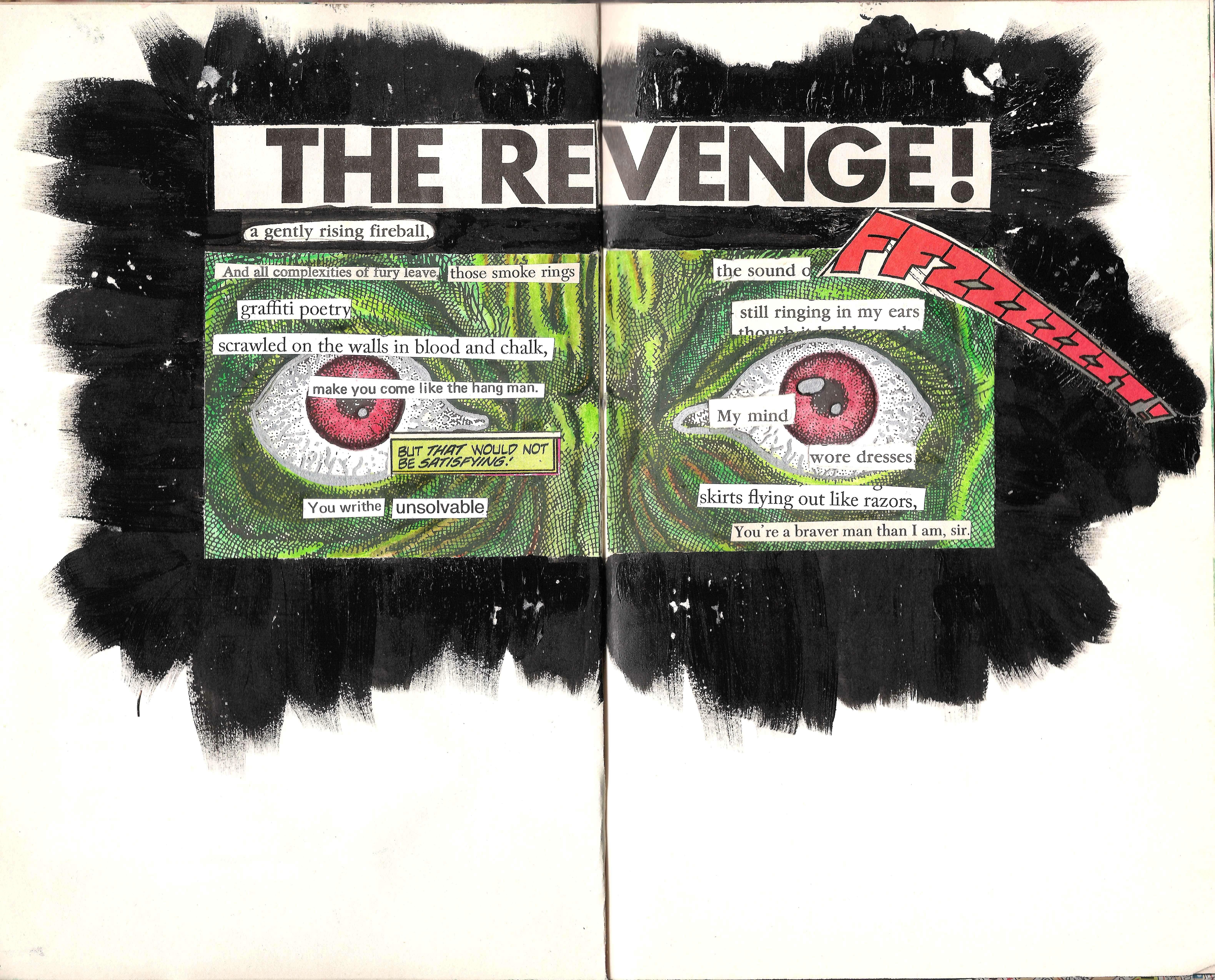
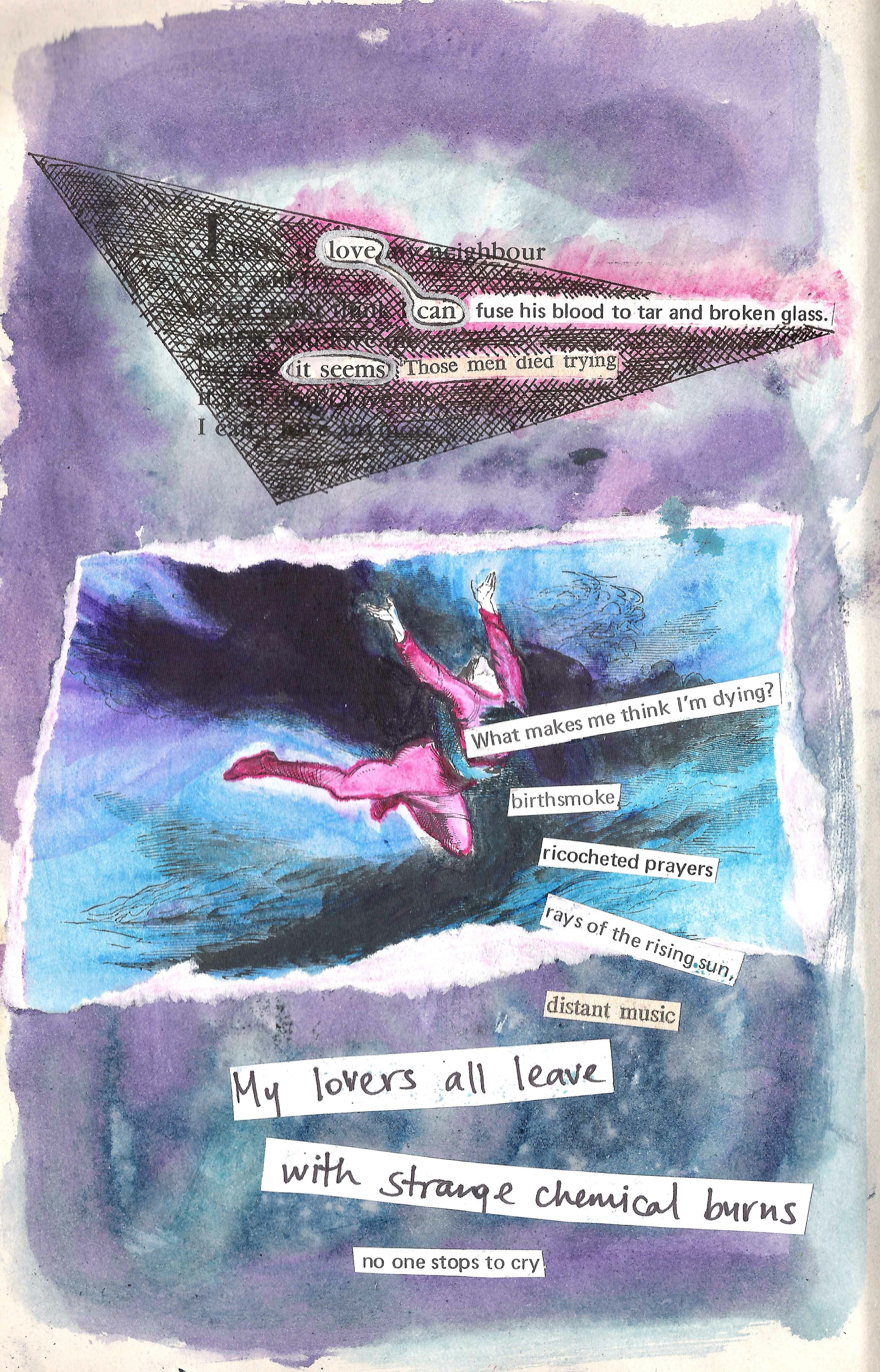
Most definitions of found poetry – sometimes called erasure poetry or blackout poetry –  employ a collage metaphor to describe how poets cut out words and phrases from texts and stick them together to create something new.

Invoking safety scissors and glue stick projects gets the basic mechanics across, but  doesn’t do a great job of conveying found poetry’s intentionality and art. My favorite description comes from Annie Dillard’s introduction to her collection of found poems, MORNINGS LIKE THESE:

Those happy poets who write found poetry go pawing through popular culture like sculptors on trash heaps. They hold and wave aloft usable artifacts and fragments: jingles and ad copy, menus and broadcasts — all objet trouvés, the literary equivalents of Warhol’s Campbell’s soup cans and Duchamp’s bicycle. By entering a found text as a poem, the poet doubles its context. The original meaning remains intact, but now it swings between two poles. The poet adds, or at any rate, increases the elements of delight. This is an urban, youthful, ironic, cruising kind of poetry.

Not only does Dillard’s definition provide a clearer picture of both found poetry and the people who write it, but it also gives us a better understanding of its detractors. Editors who will inevitably cry “plagiarism!” and “unoriginal!” are but a few branches down the family tree from the conservative art critics who turned up their noses at readymade and pop art in the mid-twentieth century.


Finding a Good Poem

© Jake Bouma.


Imposing parameters or restrictions on experimental writing like found poetry is usually considered bad form; however, working on the The Found Poetry Review has forced me to make decisions about what I consider a quality poem.

I’d put the types of submissions we receive into three broad buckets:

1.     Reportage: These pieces excerpt sequential lines from a source text, with the primary intervention being the addition of line breaks or spaces. Photographs of juxtaposed signs or graffiti also fall into this group.

2.     Distillation: Poems in this category take words and phrases from a source text, rearranging them into a final piece that retains the text’s general message but is arranged in a new way.

3.     Reinvention: Submissions falling into this group take words and phrases from a text, but arrange them in ways so that the poem’s meaning has little or nothing to do with that of the source material.

Most of the poems we accept at The Found Poetry Review come from the second and third groups. When evaluating traditional poetry, editors look for originality in words and sentiment; in found poetry, I look for originality in arrangement. What can you add to the source material? What new story can you find within the original?

Poems from the first group are problematic for me, both as an editor and a writer of found poetry. Singling out a pithy paragraph in Lolita, pressing the return key a few times and calling it a found poem doesn’t do much for me on the editorial front – it’s not surprising or inventive. More significantly, as someone who writes found poetry and tries to build a case for it’s value and art, I see these “reportage” poems as walking too fine a line between plagiarism and ingenuity.


Where to Begin: Crafting Your First Found Poem

Because found poetry is experimental and so individual, I encourage curious writers to jump in first and read examples from the field later. You need to play around before you can get serious.

Since you’re presumably reading this post on the Internet, Wave Books’ erasure tool is a great place to start digging. There, you can choose one of 20 source materials to work with, then use an interactive tool to click and erase words from the text until you arrive at a final poem.

When working electronically from a web-based source (Project Gutenberg, with it’s wealth of public domain source texts, is a good place to begin), you can also consider pulling up two windows side by side – one with your source text and the other with a blank Word document. Skim through the text quickly, copying over into the document interesting words and phrases. Condense and reorder those snippets to create your found poem.

Offline, approach any text – from your morning newspaper to your favorite book to your pile of junk mail – with a pen in hand. As you read, underline or circle words and phrases, then try to work them into a poem. You also have permission to get out those scissors I referenced at the beginning of this post – cut up texts into strips, mix them up and then physically rearrange them on a board or table.

Enlarge Your Practice by Learning from Others

After you’ve taken some time to play around and understand your natural instincts when it comes to writing found poetry, take the time to read what others are doing in the field. Seeing how other writers approach the same art form – and perhaps even the same texts – will help you enlarge your practice.


Below is a short list of some published works of found poetry to buy online or request from your local library:

Online journals such as The Found Poetry Review and Verbatim Poetry also feature plenty of examples from other poets that may spark an idea for your own work.

Finally, be sure to let others learn from you. Post your found poetry on your blog or website, introduce it to your writing group and submit your works to online journals for publication. If you’re a teacher, try a found poetry exercise with your class.

If you’ve written found poetry or have favorite pieces from others to share, be sure to post the text or a link in the comments section below!


Jenni B. Baker.

Jenni B. Baker is the founder and editor-in-chief of the Found Poetry Review. Her poetry has appeared in over a dozen publications, including InDigest Magazine, The Newport Review, qarrtisiluni and BluePrintReview. She is currently working on a manuscript of found poetry derived from David Foster Wallace’s Infinite Jest, titled Fest.


If your life is burning, well then poetry is just the ash.
–Leonard Cohen

Words.  God, I love them.  Unpredictable.  Knotted.  Liquid.  Percussive. Baked and flat.  Round.  Grainy.  Leached and slim.

And the silences.  I love them more than words.   Empty.  Heavy.  Thorned.  Sometimes taut.  Sometimes fat.  Glassy and stilled.  Ridged.  Slicked.  Stuffed and flexed.

I wrote my first poem when I was 4.  I would like to say it was mensa material, but frankly, it was terrible.  What I still marvel at is that I was always drawn to this form of expression.  I didn’t know what a poem meant but I loved it purely.  The value of words, their weight, their counterweight.  The vowels, the bones, the muscles.  Weeding through the fat.  Now, I recalibrate daily to stay as much as possible in that original love.  To resist wanting to control the words.  It’s a fight to not domesticate the poem.

Process.  Every time.  Walking into each poem, the moment can turn out to be as small as a second and as big as a bull ring.  For me, it always feels like a blood sport.  Primal but epic.  Personal yet external.  Once I exhaust myself, I can slide into surrender.  Finally, I can give in to the release that builds when you let the poem rise up.  Sometimes it hunts me.  Sometimes it wades.  Sometimes it’s a whisper that I have to grab the tail of and wrestle down.  I like the surprise and letting the alchemy take over.

And then of course, there is the poem that resists me.  For months, I keep catching glimpses.  I know it’s there.  It’ll make eyes at me and poof, it’s gone.  Occasionally, it will come back.  And when it does, I have to be ready for it.  I have to be a snake charmer, very still and seductive, to trap it while it’s doing its dizzy dance.

After that, comes surgery.  Not always but often.  The pruning but not over pruning.  I mustn’t carve out its heartbeat.  That has to stay wild, untamed.  The poem must maintain its ineffable urge that brought it from a thought spark to paper.

And finally, comes the selfishness.  Poetry is my high.  I’m an addict.  Greedy for words.  And even more greedy to be unlocked.  To feel like I’m sitting in the lap of life. In sync.  With secrets dropping from the sky.   I want to burn up life.   And poetry is just the ash.

You see, I want a lot.
Maybe I want it all:
the dakrness of each endless fall,
the shimmering light if each ascent.

–Rainer Maria Rilke


Elena Evangelo.

Elena Evangelo was born and raised in New York City’s Chelsea district to Greek immigrants.

She graduated from Vassar College with her B.A. in English and French. Afterwards, she received her M.F.A. from the USC, School of Cinematic Arts, graduating Phi Kappa Phi. There, she was also awarded The Jeffrey Jones Screenwriting Scholarship and The Ray Stark/ Ted Turner MGM Award. Elena also went on to Paris to study French Theater through NYU.

Elena has appeared in the films G.I. Joe Rise of Cobra and Purpose and is slated to star in the epic East of Byzantium. Her television work includes roles on Justified, Revenge, Body Of Proof, CSI Miami, 90210, Monk…

She is also a published poet and continues to produce and direct films.

Australia / New Zeland

SUSIE: Hi Stacey! For people who don’t know you at all, can you start by introducing yourself?

STACEY: Hello Susie + reader, I am 23 and I live inAuckland, NZ. I work with animals, write poetry and make zines. How would you currently describe your own creative output?

SUSIE: Creative output is a big sort of term … I guess I kinda write poetry from time to time, I really like baking and crafts though. Sometimes I feel like a bit of a housewife in terms of my hobbies but writing-wise, I made some zines about crushes a few years ago … and this year I’m trying to make enough poems/stories for a chapbook. What were your zines about? How did you transition from working with animals to writing poetry?

STACEY: The zines I write are mostly ‘personal zines’, and they help me to catalogue my life in a way. For example, I am doing a zine for every season, and in those zines I put bits of writing and poetry, drawings, etc that are loosely related to the season and/or that three-month period. The fact that I work with animals and write poetry have little to do with each other, although I suppose I have referenced animals a bit in my poems, so it’s not like the two things are mutually exclusive. They are two things I love, but I see working with animals more as a career and writing poetry more as a hobby. Do you think you could ever make writing into a career of sorts? What do you want to do as a career?

SUSIE: Hm, that’s interesting, I never would have thought of zines as not being personal. For me, at least, being personal is what makes a zine good. It’s just interesting to see the different sort of lifestyles that poets have and whether this is reflected in their poems or whatever. As for me/my career, I dunno. I really like doing communications (marketing/promo/social media) for arts things, whether that be festivals, galleries, websites or whatever. I like connecting people with creative stuff. Is that a career? Sometimes, I think it would be good to write a novel but I know I am a loooong way off ever doing that. What about you? You have been published on a whole bunch of websites, would you ever think seriously about trying to do the same in print?

STACEY: Well, I mean ‘personal zines’ are just one type of zine, there are a tonne of other types of zines to do with politics, feminism, music, art, etc. I see what you mean about poet lifestyle, for e.g. people who have actually studied English and want to be a writer or people like me who have completely unrelated aspirations. I don’t think I could make writing into a career because I enjoy not having to be pressured to write. Writing is a function of my body, it’s like an exhale of breath. If I had to write about specific things, deal with deadlines, etc, it would seem less natural to me.

It seems like nowadays the only time I submit to anything is if I am personally asked to, so I mean I don’t feel overly concerned about being published in print. I feel more interested in self-publishing my own chapbooks sometime in the future. Do you think there is more value in a poem being published online or in print?

Cordite Online

SUSIE: That’s a real good question and it’s something that I sort of wanted to get at with the thesis I wrote last year. But I think the key word there is ‘value’. I mean there are so many types of poetry that appeal to people for varying reasons, so somebody might find that the type of poetry they like online, so for them a poem found online would be more valuable. But for others the same could be said of print. I think the ways that poetry is finding a home online, through online archives and websites like the poetry foundation, and then start up journals like All Write Then, Let People Poems, funded journals like Cordite Poetry Review, or other poetry projects that can only be done online (likestarlings, internet poetry, or RMIT poetry).

These, for me, are valuable, because they unite poetry with a new demographic/audience, unlimited by geography. Also, they provide relative anonymity and diminish a literary hierarchy that sometimes dominates print poetry. But having said that, I really like print objects and that was one of the reasons I thought it would be cool if we made Hands Like Mirrors. And also, I think online poetry influences print communities. But that is a bit of a different story. Can you explain your idea of the philosophy behind HLM? What did you like most about making it?


STACEY: For me, it seemed like there were no publications that featured predominantly young NZ writers, or at least, there were no publications that featured the kind of poetry and short fiction that I personally wanted to read. You felt the same to some extent, thus we decided to make a print publication featuring young NZ and Australian writers. The most exciting thing for me was looking for people to contribute to it. I did a call out for submissions but I also did a lot of research, talking to everyone I could and asking if they knew anyone who wrote, asking friends and friends of friends. We ended up with some really good content. How did you feel about the end product of HLM? What do you think could be done differently for the next issue?

SUSIE: I loved it. It was a really rewarding thing to do and is something I’m really proud of. Next time I’d like to make it bigger and try to get more artists involved so we can get more visuals in it. I also want to work harder on stocking it places so we can share the lovely words people wrote with more peeps. I’d also like to have a launch inMelbournenext time. It’s a lot to take on but I think doing the first one was a really good learning experience, so I’m looking forward to doing it again.


There are a limited number of the first Hands Like Mirrors journal still available. See handslikemirrors.tumblr.com for details and stay tuned for news about HLM 2012!


Stacey Teague & Susie Anderson

Susie Anderson and Stacey Teague met about 6 years ago on Livejournal. Since then, they have shared a love of poetry, giggling, cats and general merriment. They keep a blog of poetry and general life things together where they make poetry podcasts. Last year they collaboratively edited the journal Hands Like Mirrors, which features writers fromAustralia andNew Zealand. The pair blog at vehementoolbox.blogspot.com, where you can find links to poems, stories and other things they’ve written.


Plato

Many see poetry as far removed from everyday communication. Generally, it would be acceptable to say that one was harassed by ‘a million mosquitoes’ when there were probably no more than thirty. Or to characterise a satay as ‘sweet’ when, really, it had a hint of citrus, a trace of fish sauce, a few bitter, burnt nuts. When using language on this pragmatic level, the underpinning criterion is that of intelligibility: Are my words sufficient to put my point across? With poetry, there is a greater sense of responsibility. To the poet, it is imperative that words — brittle and mutable and fleeting as they may be — are deployed with the utmost concern for both clarity and connotation, understanding and undertone.

Despite this, Plato warns against poetry’s power to ‘seduce’ the intellect. In The Republic, he contends that poetry leads us away from the Truth arrived at through logical argument (and the capital is here deliberate, for Plato was using the term in its putative, oppressive sense — Truth that is ‘out there’, untouched by culture and context). As poets focus on the sensual and empower emotion, Plato feels they celebrate the world as it is to the ‘everyman’, not the philosopher. And as such, they are no different to the Sophists, Ancient Greece’s masters of rhetoric, who swayed audiences through emotive language instead of logic.

Plato’s view betrays what ties philosophy with both poetry and rhetoric: the idea that words are immensely powerful. In their various forms and combinations, words have the capacity to inspire and transform, to enrich and enliven. They can also injure, bemuse, denigrate and eradicate. It’s this spectrum of effect that poetry manages to access, thereby articulating aspects of the world that elude overly logical and pragmatic thinking. To be clear, I’m not denying that philosophy is crucial to our understanding of the world (I studied philosophy in university and fancy myself a philosopher, after all). Nor do I disagree that sometimes it would be excessive to use words with poetic exactitude (my work as an editor plays itself out here). Rather, I’m focusing on the point — which Plato himself admits — that poetry helps to foster an inclination to appreciate beauty: it trains us in the appreciation of Truth.

Seamus Heaney


In more contemporary times, poet Seamus Heaney discusses how poetry can ‘redress’ aspects of this world, allowing us to see it in a more consoling, more exciting light. And the source of these alternative views is the poet’s imagination. But for these to be tangible to their readers, poets must tap into a ‘new world’ in which the ideas and ideologies that predominate are theirs. What results is a sort of ‘creation through destruction’, whereby the socio-political structures of the ‘real world’ are usurped by the poets’ imagined ones. It is this that leads to poetry’s distinctive use of words. Metaphors and metonyms are not merely gratuitous diversions from convention; rather, they are the indispensable tools with which poets actualise their worlds. How else are poets to describe the particular yellow of a sunrise, or the heaviness of the chest that results from watching a loved one being shot?


W. H. Auden

To Heaney, what poetry does is offer non-poets ‘another truth to which we can have recourse, before which we can know ourselves in a more fully empowered way’. The truth (lowercase this time) that he identifies may not be universal in Plato’s sense, but it is nevertheless universal because it highlights the shared-ness of the world being written about. Despite the need to create a world for themselves, poets still take inspiration from the ‘real world’— why else would figurative language be necessary, if not to link the imagined with the real? This ‘empowers’ readers in two ways: first, because the same world is seen through different (more poetic) eyes; and second, because these poetic views can be incorporated into the everyday. Much like the prophets of yore (and, indeed, philosopher Martin Heidegger has equated poets with prophets), it seems the duty of poets lies in seeing a little more than is needed, in hearing whispers in abandoned places, in rousing the populace from its complacency — in offering more truth than Truth can ever provide.

In this light, Plato’s characterisation of poetry can seem a little unwarranted. Poets may not bring Truth, but they do invoke truths of their own creation: truths of a subjective kind. So it’s no wonder that, unlike pragmatic communicators, poets are so scrupulous with their words — after all, these words bear the weight of ‘prophecy’. A colleague (a fellow editor with a PhD in poetry) once told me that, as part of editing, she asks writers to justify each word they’ve used in a stanza or paragraph. The reasoning behind her (yes, quite severe) method is that poets should know their words intimately. Auden encapsulates this idea well when he wrote:

Language is prosaic [or, in terms of my dichotomy, pragmatic] to the degree that it does not matter what particular word is associated with an idea … Language is poetic to the degree that it does.

Indeed, truly poetic works are those that have not only mastered this process of refinement, but also revel in it. The poet’s gift to the reader is a world that has been carefully conjured, lovingly built of imagery, line-break and rhyme. For what else is poetry, if not poeisis (Greek for ‘creation’)?


Adolfo Aranjuez


Adolfo Aranjuez is the editor at independent publisher Melbourne Books and its annual anthology, Award Winning Australian Writing. He is also a nonfiction editor and sub-editor of the literary journal Voiceworks, and the editor of arts and culture magazine Fragmented. This post is a modified excerpt from Adolfo’s ‘Editor’s Introduction’ for Award Winning Australian Writing 2011. The 2012 edition, which will feature a foreword by the 2011 Montreal Poetry Prize winner, Mark Tredinnick, is due for release later this year.

I know next to nothing about poetry. This is a recent development; it hasn’t always been this way. On the very week in early September that I officially signed up as a poetry editor for the magazine Pathlight: New Chinese Writing, my father, who had Lou Gehrig’s disease,passed away before I expected. This sudden disappearance of the man who taught me poetry awakened me to the fact that my poetic aesthetic was fundamentally his, and that I had but few truly independent opinions. Yet it was at this juncture I made an acquaintance who seemed to be on the same path as I, and whom I hope will continue to walk with me in the future. I share this relationship temporarily with Chinese poetry.

My father the poet was an American Modernist. He admired structure, but only in the service of the meter-making argument. He memorized Yeats (as did I, eventually), admired Ezra Pound’s prose but hated the Cantos, adored W.H. Auden. Ferlinghetti was spotty at best, and Ginsberg absolute anathema. An English teacher before he was a farmer, he taught me poetry out of a textbook called Sound and Sense, by Laurence Perrine. It’s a very well-done book, yet only five months ago, as I was taking stock of the poems I knew well, I discovered that all the pieces I could recite in full came from there, while the poets I had sought out over the years were sort of cut from the same cloth. As for the poetry I wrote, well, my father had been my most consistent source of criticism all along, so there was even less to say.

I’m certainly not trying to refute any of my father’s poetic principles, which he gleaned through years of writing and waiting, or to demean their importance, but only to suggest that no matter how significant the father’s ideas be, the son still has to form his own.

I think a lot of new Chinese poems betray the same sort of pressure.

We take for granted that bending and subverting ideology is something all poems do by definition. Yet I see Chinese poetry distancing itself also from two outwardly positive traditions, the ponderous canon of ancient Chinese poetry on one hand and contemporary English-language poetry, which slid into Chinese poetry as the Chinese language was Anglicized, on the other.


The Body and History
By Xi Chuan, translation Lucas Klein

Double corneas, earlobes hanging past the shoulders, arms surpassing the knees,
and occipital bones protruding from the back of the head—
people who suffer such are bound to be buried. History is not theirs to decide.
Instead they have to show off their intelligence and usefulness by currying favor
with people of more conventional appearance.

Covered in spurs, webbed fingers and toes, the triple-headed and six-armed, third
eye wide open—
people who suffer such hurry past, never living up to the hopes of those with more
conventional appearance.
After death they choose to follow behind those of conventional appearance,
stepping in silence to make sure they have food and drink.

History disguises itself as a storyteller to obsequiously flatter those people with
abnormal bodies.
But in the end it doesn’t give a damn about them, as if they were just earwax or eye
crust.
History disguises itself as a person I know (name withheld); this person both
fetishizes novelty and has conventional tastes.

Published in Pathlight #1 and Notes on the Mosquito


Obscure to a Western reader, “double corneas” and heavy earlobes are references to Xiang Yu and Liu Bei, two of the great heroic figures of early Chinese history. In fact, all of the described abnormalities are references to specific mythicized figures. They are characters whom historical and poetic narrations have always served, never satirized.

This English translation, the careful work of Lucas Klein, also transmits another distinct characteristic of Xi Chuan’s work: its intentional arrhythmia. If one look at the poem closely, one will find the constant meter of regular human speech frequently interfered with. Bei Dao and Yang Lian have done this before, too, though not always so consistently. Now, this is a supposition, but I expect Xi Chuan and many of his contemporaries are as sick as I am of having to hear about Tang poetry. The lovely square poems of Du Fu, which are marvels of introspection and craftsmanship, are still ancient history.

Another influence I see being battled in Chinese poetry is the tendency to sound American. I have read a number of poems in Chinese that feel like translated contemporary American poetry. On a linguistic level, this is in a limited sense unavoidable, as the Chinese language has been Westernized so drastically over the past hundred years, and the speed never slowing. As Xi Chuan once pointed out, Chinese was originally a short-sentence language, and it was the coming of the works of Marx and Lenin in Chinese that made it into a long-sentence language. In the 1920’s, poets like Xu Zhimo and Bian Zhilin tried writing sonnets and other forms of English formal poetry using Chinese; in the 80’s and 90’s a large amount of work was produced in imitation of Beat poetry. Not to oversimplify; those were both times of wholesale importation of Western ideas, which were valuable because they were new. Now, I see Chinese poets trying to leave that alone—not with the bombastic, jingoistic language of their “literary officials,” but with unpretentious expression:


Prayer-Poem on Mt. Jinuo
By Lei Pingyang, translation Eleanor Goodman

Oh spirits, thank you for
letting us catch a small deer today
please let us catch a big deer tomorrow

Oh spirits, thank you for
letting us catch a deer today
please let us catch two deer tomorrow.

Published in Pathlight #1


Tuyugou Village
By Shen Wei, translation Eleanor Goodman

Village in a valley. The hillside is a graveyard
Year by year the village shrinks, day by day the graveyard grows
The village is below, in the deep shadow
The graveyard is above, under the intense sun
In the vineyard the villagers pick fruit, bustle about
When they raise their heads, they gain from the dead
an angle from which to look down at themselves, a pair of eyes

Published in Pathlight #2


Lei Pingyang and Shen Wei can get a little too affectedly “ethnic” at times. How about one from Zhai Yongming:


In Springtime
By Zhai Yongming, translation Andrea Lingenfelter

In springtime, when a treeful of artificial flowers blooms like a face flushed with wine
I long for tradition                  Those real mountains
real waters                   realistic paintings of real birds and flowers
Those colors that gave young girls beautiful complexions
were derived from plants                    Their beauty
came from life

Sleeping in the mountains       also became a tradition
like the practice of a yogi
Thinking of that Master          in the mountains
waking            washing           training
born to poverty
disconnected from all dynasties
meeting up      in poems
in paintings
in lotus leaves  or among schools of fish

Nursing a sense of antiquity I can’t shake off
I use a brush: broken brushwork, dry brushwork
Splintered brushwork, parched brushwork
can’t prop up this inner lethargy
When paper and ink turn in towards the heart
they fly onto a section of landscape

Published in Pathlight #2


I like this poem because it makes good use of the interpretive space that exists between Chinese characters in logical progression. This is due to a phenomenon in the Chinese language called parataxis, which I’ll leave you to look up on dictionary.com.

If you trust these are all good translations, you’ll see what I mean about the poems feeling influenced by contemporary American poetic language, in terms of how their voices are shaped. At the same time, you can also detect an attempt to put that influence down. As for what will come of that—well, if I knew that, I might be said to know something about poetry.


Canaan Morse.

Canaan Morse began translating literature in the fall of 2006, when he translated and prefaced Wang Shuo’s novella The Stewardess for his senior thesis at Colby College in Maine. Immediately after graduation, he returned to Beijing to spend another year in school-two semesters of intensive Chinese at the Inter-University Program for Chinese Studies at Tsinghua, where he first seriously took up Classical Chinese and May Fourth literature as subjects for appreciation, study and translation. He currently resides in Beijing, China.

Stress and the Sestina

I’m not going to ask you to imagine you live a crazy life. I’m going to assume you do.

I’m going to assume one or all of the following things: that you work long hours, pay high taxes, argue with your lover, can’t work out, overeat, forget to eat, chase your kids, get stuck in elevators, run out of money, miss deadlines, drop phone calls, cry at job interviews, have a messy car trunk, have a cold that’s turned into the flu that’s turned into bronchitis that’s turned into an unexpected hospital visit, that you didn’t get promoted, that your vacation got rained out, that you saw your ex, nothing fits, and you’re a very horrible writer with no time to read anymore and only watches reality shows to see other people lose. I bet that at least three of these things describe how you feel about yourself and if it makes you feel any better, I feel that way about you, too. I know you live this crazy life.

And guess what? You’re okay.

You’re still awesome. And I’m going to help you see your way through all this stress, and back to your superior awesome self. You can’t run, you can’t hide, but you can find the peace in the place where you stand/run/walk/panic/scream/shut-down/laugh. It’s all about framing and form.

It’s all about the safety of the Sestina.

Some poets and poetry lovers know about the sestina and some don’t. Sestina is kind of a big-shot recluse in the poetry world. Imagine a sestina as a hipster’s favorite new band – most poets won’t read or write or know them, and a few will acknowledge them, and some will go so far as to basically tell you, “You’ve probably never heard of it, but Sestinas are where it’s at, but y’know, it’s kind of my thing. I’m going to a Sestina Festival this Fall but don’t try and get a ticket, ‘cause it’s already sold out.”

So, I’m going to break it down for all of us: why sestinas can bring a sense of order into our unruly lives, why they are an indulgent escape when the world is just too much with us, and most importantly, why the sestina should be defended at all costs.

The sestina is a 39 line poem, consisting of 6 stanzas that are 6 lines each. If you’re good at math, you realize that only adds up to 36. Then the sestina need 3 more lines at the end of the poem which will be in the form of an envoi. Envoi always sounds like an amazing all girl R-and-B group, but really it’s a short stanza that addresses the poem before it, or can be addressed specifically to a person, real or imagined. So, just so we’re following each other, so far a sestina looks like this in number terms:

6 (stanzas) x 6 (lines) + 3 (lines-envoi!) = 39 lines

Why do I lay it out like this? BECAUSE YOUR LIFE IS COMPLICATED ENOUGH! The sestina form is straightforward. You can play with the words, but the sestina is a fixed verse form – don’t let that intimidate you, it’s just a template- and you my friend, don’t need an more complication in your everyday schedule. Let the template work for you.

And then the next part of the equation comes – what do you with these 39 lines? Well, this is where you get a little mind exercise – and because it requires some focus and attention, that means you can’t concentrate on anything else – like laundry, bus fare, and your dreams of delight and despair.

The words that end each line of the first stanza are used as line endings in each of the following stanzas, rotated in a set pattern. They are usually iambs, but do not have to rhyme internally or externally. Sound crazy making? Maybe. But it can also be fun and relaxing.

The repetition that is found throughout sestinas helps me work out what I can’t let go of – my anxieties, my fears, a story that’s stuck in my brain, the upcoming Presidential election. It’s a way for me to take an idea or event that may play itself out in the middle of the night as a fever dream and pitch it into a form, give it a place to live, and if I’m lucky, find a reader who knows exactly what I’m bitching, moaning, groaning, giggling about and obsessing over day in and day out. Stephen Fry, in his book, THE ODE LESS TRAVELED, writes that the sestina is a place for “repetition and recycling of elusive patterns that cannot be quite held in the mind all at once.”

If you could take just one thing that stressed you out and give it a home that you could always visit but never had to stay longer than you wanted, wouldn’t you at least try it? (That’s what I’m hoping!) And if you don’t trust me, at least trust Stephen Fry. He’s much cooler than me.

So, back to it. You take the last word of each line of the first stanza and use it as line endings in the next stanza. The second-sixth stanzas use a bottom-up pairing. The pattern goes something like this (yes, more numbers here):

And the envoi ends with 3 lines, as we know. Those 3 lines should include all 6 line- endings from the preceding stanzas.

By now, you probably thinking I don’t have time for this counting and checking. I just want to write a damn poem and read some damn fine poetry. And you should. And if the poem you want to write is not in fixed verse form, see if it could fit into those perimeters. See how it feels when you exercise your brain on one task, instead of running in heels to catch a bicycle while juggling a fish and finishing that book on multitasking. And then, see if your poem can work in a fixed form. Try not to fight it – it’s not one more thing you have to do – it’s a choice. It’s going to the Container Store to find the perfect box instead of using your old shoe box that smells like…shoes.

I’m going to write my sestina here, first time-first draft, no corrections. Why? So that you can see it can be done -a controlled and accessible experiment in an imperfect and chaotic world. And because it will make me feel organized, better, and in control, even if it’s all just a delusion. And because I chose stressed syllables over stressing situations. And because I’m not working for perfection here, I’m simply losing myself in writing a poem this afternoon.

There is significant freedom in the fixed word. I hope you find this to be true, too, and that you’ll write your sestina any minute now.

ROUTINE

By Kayla Cagan

There are chickens next door who strut and prance
but basically keep it down in the morning
when they know we are just waking from a dark night
of sheet-tangled dreams and twisted limbs
not ready to face the day of choices to eat this
or think that, be aware or still proceed with hope.

And as I brush my teeth glancing out the window with hope
to see the bold one or the shy one or the dotted one prance
I can’t say that I wouldn’t mind being a chicken for this
day when the it starts off as a gray morning
and they aren’t worried about what hurts, which limbs
will be worn and tired by the fall of the night.

When the moon shines and Hummer headlights flash the night,
we will climb back into bed, brains full of urgent hope
that our chests will bursts open, our hearts pulsing prayer to our limbs,
“You’re free tonight of that angry, annihilating prance
the one that keeps sleep-stinging you until morning,
you’ll be free tonight of some, of all, of not all, the thing that is this.”

A new day will happen, we’ll repeat all this,
I’ll stare at the chickens and wonder where they sleep at night,
what their routines are first thing in the morning,
if they eat because they’re hungry or without hope,
if it’s just a way of life in which they’re fatten and prance,
on those little twigs of legs, their scratchy thin limbs.

I’ll take my mat outside and balance on my silly limbs
wishing that the things that mattered were only this,
where the trio of chickens sleep and prance,
if they nosh grass all day and scratch ticks at night
if they are sanguine in understanding they will be eaten without hope
just to fill a fat man belly’s first thing in the morning.

It is this comfort I take in the morning,
knowing that I’m imperfect in my limbs,
relaxing into the hammock of hope,
that there’s really only this,
that I don’t have to worry each and every night.
I will always be filled with this jumpy little heart, my own prance.

I watch the chickens in morning and they know when I prance.
I have hope in all the hours in between, that there is not more than this,
praying our routine will carry us through another night.
*
And there you have it. A sestina written, imperfectly, in the middle of the day – when I wasn’t consumed about all of the things that weigh on my media-saturated, anxiously- ambitious brain. I actually feel like I went on vacation.

Okay, now it’s your turn. Write a sestina. Have some fun. Experiment. Escape.


Kayla Cagan.

Kayla Cagan lives in LA across the street from a famous tattoo parlor. She is a playwright, dramaturg, and novelist, and is married to the insanely funny and lovable screenwriter Josh A. Cagan. Say hi to @kaylacagan on twitter.

Amber Beilharz: What was your reason for founding Couplet Books, and what sets it apart?
Owen Davidson: Couplet Books is really the result of an aggregation of various previous commissioned poetry projects, such as We Eat Poets! (a series of fine food and poetry fusion events), and Give a Poem (a personal commissioned poetry service), among others.
The first of our publishing lines is the Poetry Companion Series, which will act as a celebration of different local areas, and a kind of alternative visitors guide. The aim is to build up a collectible series of books and pamphlets for various spots in London and the rest of the UK.
But where I think we differ from other poetry publishers is that, while we are producing titles which are designed to be commercially successful in their own right (which is not unique, but neither is it the norm), we are also working with businesses to develop poetry projects relevant to their needs and the experiences of their customers.
All of the founders of Couplet Books, Jon Stone, Kirsten Irving and I, believe that, in spite of its popularity, poetry is still seen as a marginal activity. That is what we want to challenge, and the way we will try to do it is to show that we can use poetry to respond to the world around us and produce work which is both striking and accessible. At Couplet Books, we think that there are lots of ways to make poetry more accessible, and that there should be more consumable poetry.
At the same time we are acutely aware that to achieve this, it is important to ensure that quality is at the forefront of what we do. To that end, we concentrate a lot of effort on selecting the right poets, and ensuring that they are really engaged with the commissioned work we ask them to undertake. With the HAMPSTEAD POETRY COMPANION, the first in that series, we are asking three poets to write four poems each about different places in the locality, and all of them have demonstrated strong associations with the subject matter of their commissions.
I sometimes paraphrase Steve Jobs when I am explaining what we are trying to do, by saying that often people don’t know what they like until you show it to them. That is the aspiration of Couplet Books, to present people with a poetic perspective on the things around them. People’s eyes light up when we say that we are sending a bunch of poets to various spots in their area to find inspiration there, and write poems about them, and the resulting material is very well received. It’s a popular thing, and that is as it should be.
AB: Can you tell us more about the Daily Couplet? Why the focus on couplets?
OD: Every day we publish a different couplet on our website, on our Facebook page, and on Twitter.
Our motivation for this is really two-fold (no pun intended!). For the first part, we wanted to create something fun for poets to interact with, and this was a very simple idea which ties in with our name. We are developing some other interactive, playful features at the moment, and they will hopefully begin to appear on the site in the next couple of months.
The other consideration was to provide a platform for poets so that they can reach a wider audience. The idea is that if there is a particularly catchy, clever, quirky, or interesting couplet somewhere in a poet’s back catalogue, or if they want to write something new, they can submit it, and hopefully some people who aren’t aware of them can read it, and investigate a little further if they like what they see.
From next week we will start to publish the submissions we have been stockpiling.
Couplet Books, forthcoming.

AB: What is responsive poetry? What does it mean to you?
OD: Responsive poetry, as far as we are concerned, is poetry which responds to a certain place, thing, or idea. In the case of the Poetry Companion Series, this means writing poems that respond to particular places in a specific area; such as the local cinema, coffee-shop, or park; or the ‘idea’ of the place as interpreted by local poets.
For our forthcoming HAMPSTEAD COMPANION, we are commissioning 12 poems about specific places we think ought to be included, and we have an open submissions process for anyone who has something to say about the area. Here it is on the map. The deadline for entries is the 27th of April, and so far we have been impressed with the range and quality of responses which have come in. Clearly, people have a lot of affection for the places in which they live.
In a wider, and, I suppose, more pragmatic context, responsive poetry is a concept we are trying to explore with various businesses as a way to reimagine their brands. We have on the horizon a couple of residencies whereby poets will be tasked with responding to a specific brief which aims to put in to words, or rather, to put in to poetry, the experiences people have when they interact with a place. Hopefully this will stimulate a bit of engagement with the customers of that business, and again provide a platform for the poets involved, and poetry in general.

AB: What catches your eye in the submission pile? Is there anything specific you’re currently looking for?
OD: As we are based in London, we are very fortunate to be surrounded by a great deal of exciting poets, and poetry organisations. Consequently, retaining a consistent focus on what we are doing is tough, because there are so many interesting projects going on. That said, we are always attracted by those poets who are willing to be playful, keen to try new things, and comfortable writing to commission. Two initiatives which recently came to my attention, and perhaps exemplify what I mean, are Poetry Digest, run by Chrissy Williams and Swithum Cooper, which is an edible magazine – a previous edition featured a number of guest poets printing short edible poems on to cupcakes; and Penning Perfumes, run by Claire Trevien, whereby poets are asked to smell a perfume, and use the ensuing sensual experience as the starting point for a poem. Fuselit, run by our own Jon Stone and Kirsten Irving, is another hotbed of interesting projects.
AB: What else are you working on at the moment? Any secret projects you can clue us in on?
OD: Some of our previous endeavours are undergoing a refurb, and will be informing various projects soon. One example being the We Eat Poets! series of events we ran in London last year.
Something very similar will be rolled out again later this year, with each event timed to coincide with the launch of a different Poetry Companion.
The premise behind this series of events was born out of the feeling a few of us had that while it is (in London, at any rate) pretty easy to find good poets standing up and reading or performing good poetry, it is really hard to find a reading which is a good event in itself.
So we got together with a fine foods company and a really quirky restaurant in central London, and put on a 4-course meal loosely related to a specific theme. Then we asked 3 poets to respond to the theme, the menu and the venue, and come along to the event to sit incognito on the tables with the other paying customers. As people entered, they were serenaded by Spanish guitar, and when everyone was seated, enjoying their first course, the first poet stood up unannounced (much to the amazement of the other diners on his table), and began his set. Each break between courses was punctuated by a different poet, culminating, at the end of the event, with the performance of a poem written on the night, incorporating specific details particular to the happenings that evening, and including words suggested by the audience at various points throughout proceedings.
More of those will be happening in London soon, and hopefully further afield a little later on.
AB:  What was the first poem you ever fell in love with?
OD: I think ‘love’ would be going a bit far, but the first poem I remember, is “Cargoes” by John Masefield. I was either 7 or 8, and our teacher sprung this on us and made us all memorise it.
Looking back, I think what captivated me was that it was the first time I really got an inkling that there were layers to this thing which seemed at first sight to be so insubstantial; the words somehow had more to them than usual, the sounds were evocative, and I noticed a rhythm to it. I don’t think these were new feelings, per se, just that it was the first time I noticed being affected by them all at once, and in response to something so short and simple.

Random House, 2004.

AB: What’re you reading now? What do you think we should be reading?
OD: At the moment I am reading 52 WAYS OF LOOKING AT A POEM by Ruth Padel, which is thoroughly excellent, and is highly recommended to anyone, poet or not. I think it is incredibly important to question how you interpret things (not just poems), and in this book it is done in a very intelligent, accessible way. On the poetry side, I am sifting through lots of work by people who have submitted couplets for the Daily Couplet to try to get a better understanding of who we will be featuring.

AB:  What aspect of the outside world inspires you the most?
OD: A large portion of my time is given to thinking about how we can use poetry to reimagine things around us, and I am constantly both amazed and daunted by the range of possibilities out there; it is true that we live in a world not of poetry, but of poetries.
I was chatting recently with a poet about taking decisions on what to write about, and how often the problem is not really finding the ‘what’, but rather understanding the ‘why’. The key for us is tp match the interests of the poets to the commissions – we are working with an artisan butcher shop right now, and will be sending a poet to one of their tastings in the next couple of weeks; we happen to know a poet who is absolutely crazy about this sort of thing, so that one was very easy to reconcile. When we get it right, the poet’s imagination can really run wild, and the result is generally some really authentic material which is well received by the audience. This is the premise on which most of our work is based, and it is what really inspires me to keep doing what we do.

AB: Why poetry?
OD: I am not all that well informed about the contemporary situation in the US, but in Britain, poetry seems to occupy a dichotomous place in the public consiousness. On the one hand, the poetry scene is thriving; it is fabulously rich and exciting, with all sorts of talented people producing amazing work; poets popping up at festivals and teaching in schools all over the place; and lots of coverage on radio and in newspapers. Yet in spite of this apparent popularity, poetry is still seen as a marginal activity, and that is what we are keen to address through the things that we publish. I guess that is what keeps me involved, and retains my interest.


Owen Davidson.

Owen Davidson grew up in the North East of Scotland, before spending much of his early adult life working, travelling, and studying in France, Spain, Germany, Russia, and the USA. For the last 5 years has been living in London, working on a number of different commissioned poetry projects, such as We Eat Poets!, the critically acclaimed series of fine food and poetry fusion events. In 2012 he founded Couplet Books, a poetry publisher specialising in responsive poetry. Its first project is the Poetry Companion Series, a range of pamphlets and books which act both as celebrations of local areas, and alternative visitors guides.